
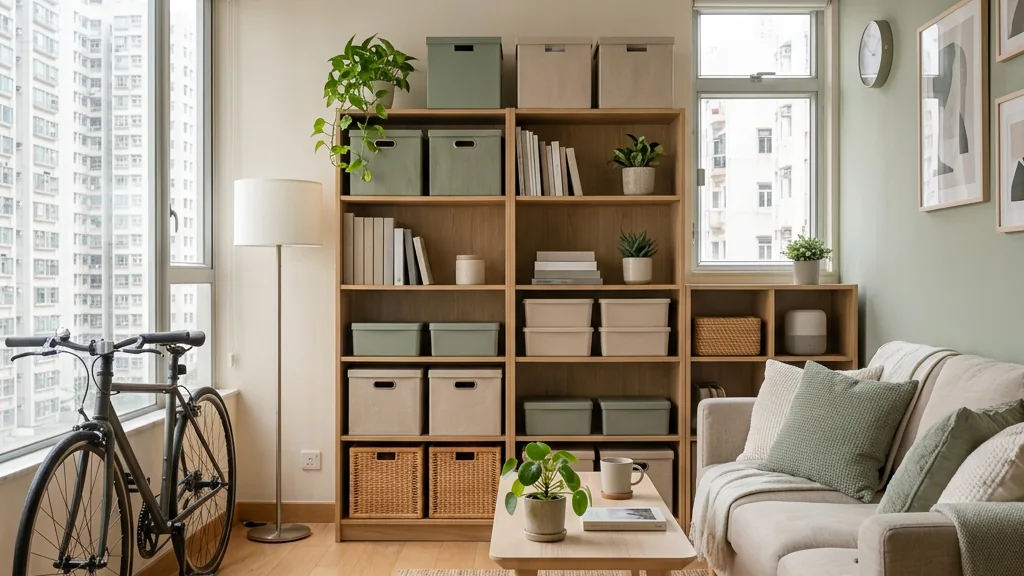
By offloading rarely used items to external storage and keeping only high-frequency essentials indoors, tenants can effectively reduce clutter and reclaim valuable living space.
In this city where land is worth its weight in gold, whether you are a young person entering society renting a 'tong lau' (tenement building) or a single-building old apartment in the city, or moving into a modernized youth apartment that has emerged in recent years, 'small units' have become the residential reality that most tenants cannot avoid. Faced with high rents and limited usable floor area, renting a transitionary home has become the top choice for many young office workers, slashies, or freelancers.
However, when you happily receive the keys to a studio unit of several tens or over a hundred square feet, the cruel reality challenge often follows: suitcases, seasonal clothing, camping gear, sports equipment, spare appliances, and daily sundries that have nowhere to go, instantly clogging up space that was never large to begin with. Many fall into an extreme vicious cycle: to cram more things in, they buy full-house storage cabinets, only to find the already narrow hallways densely packed, feeling suffocated the moment they walk in, and quality of life drops sharply.
How exactly should tenants of small units cleverly use 'external space' to find the perfect balance point between clutter and quality of life? Here is a comprehensive in-depth breakdown for you.
Why does cramming all clutter into a small unit completely destroy quality of life?
Before exploring how to utilize external space, we must first understand why 'cramming everything indoors' is a disastrous decision:
Mental stress caused by visual crowding: A cluttered visual environment can affect comfort, so organizing items to keep living areas clear is recommended to reduce stress.
Loss of core living space: When most of the room's area is occupied by storage cabinets and clutter, you will be unable to carry out normal activities at home—want to roll out a yoga mat to exercise but find nowhere to stand; want to seriously cook a meal but find the kitchen countertop piled high with clutter. The compression of space directly deprives life of its due dignity and flexibility.
What exactly is 'external space'?
To break through the physical limitations of small units, modern tenants must learn a brand-new spatial mindset—'space outsourcing'.
What is external space? Simply put, it means transferring those 'large or bulky items that are used with extremely low frequency but are indispensable' to professional external spaces outside of your rented unit. This is not just simple clutter piling, but a high-efficiency resource allocation:
Traditional Mini Storage: Suitable for storing large suitcases, seasonal quilts, folding bicycles, or large quantities of books and files.
Door-to-door storage boxes: Staff come to pick up specified plastic boxes to be stored in a central warehouse with constant temperature and humidity. When needed, you can book delivery via a mobile App with one click, which is very suitable for young tenants who do not have cars and do not want to carry items themselves.
Making good use of shared spaces and community facilities: For example, making good use of the communal gym, rooftop garden, or shared kitchen attached to the apartment building to 'outsource' part of large-scale activity space to outdoor public areas.
Practical deployment: How to define the golden boundary between indoor and external space?
To truly balance quality of life with daily clutter, you must strictly implement the 'frequency classification method' and divide items into two distinctly different worlds:
Boundary 1: The high-frequency core area remaining indoors
Definition: Essentials used at least once a day or once a week.
Contents include: In-season clothing, daily skincare products, a few sets of commonly used cookware, a comfortable bed, and a multifunctional desk.
Principle: Indoor space should only retain items that can directly enhance 'current sense of happiness', keeping the line of sight minimalist and clear.
Boundary 2: The low-frequency backup area transferred to external space
Definition: Items used only once every half a year or even once every few years, but which absolutely cannot be discarded at specific times.
Contents include:
Seasonal clothing and heavy quilts: Store heavy down jackets and winter quilts in summer, and swimwear and rattan mats in winter.
Large suitcases and outdoor gear: Camping tents, hiking backpacks, large suitcases (these take up extreme space at home usually).
Collectibles, memorabilia, and spare appliances: Large air fryers that are not commonly used, festive decorations, etc.
Quality of life upgrade: The 'psychological and lifestyle bonus' brought about by making good use of external space
Once you have successfully transferred low-frequency clutter to external space, you will find that life has undergone a drastic qualitative change:
Space with freedom to breathe: With no clutter piled up indoors, your field of vision instantly opens up, room ventilation and natural lighting are maximized, and the sense of residential happiness doubles.
Reclaiming personal interests and socializing: Because you have a clean and spacious living room, you can invite friends over at any time, or exercise, read, and draw freely at home, truly achieving the goal of 'a sparrow may be small, but it has all the vital organs'.
Relocating becomes easier than ever before: As a tenant, when the contract expires and you need to move, because most large clutter is already deposited in an external warehouse, you only need to pack a few boxes of luggage to move house dashingly, bidding farewell to the feeling of breakdown when facing a house full of clutter during traditional moving.
Seek professional team assistance
Utilizing external space is a method for managing your home. For moving large quantities of items, professional assistance is recommended to ensure safety and prevent damage, rather than attempting to move heavy items alone.
One Plus One Storage Services
One Plus One Storage provides professional mini storage services, dedicated to offering citizens flexible, convenient, and reasonably priced storage solutions. We have an in-depth understanding of the land supply shortage during Hong Kong's urbanization and the current trend where changes in work patterns have led to an increasing need for home space. Therefore, we founded One Plus One Storage to respond to these growing demands.
Our mini storage units come in a variety of sizes; whether customers need small storage space for personal items or large storage space for company files or furniture, we can provide suitable solutions. Furthermore, our pricing is fair and transparent, and we offer flexible lease terms, allowing customers to choose flexibly based on their own needs, whether for long-term or short-term rental.
Welcome to request a quote or make inquiries: Click to contact us via WhatsApp
- Address: Room 16-17, 9/F, Nan Fung Commercial Centre, 19 Lam Lok Street, Kowloon Bay
- Phone: 3188 1889
- WhatsApp: 6928 9628
- Email:enquiry@opostorage.com
Feel free to contact us anytime; let us provide you with professional mini storage.
Practical storage and planning
- Categorize your belongings by usage frequency to identify high-frequency essentials and low-frequency back-up items.
- Transfer bulky seasonal items or infrequently used gear to external storage facilities to free up indoor space.
- Hire professional teams for the handling and transport of heavy or delicate items to ensure safety.
Frequently asked questions
How do I determine if an item is suitable for external storage?
Consider storing items that you use less than once every six months and that occupy significant space in your daily living area.
Further reading: US National Archives guidance on storing papers and photographs; Canadian Conservation Institute guidance by material