
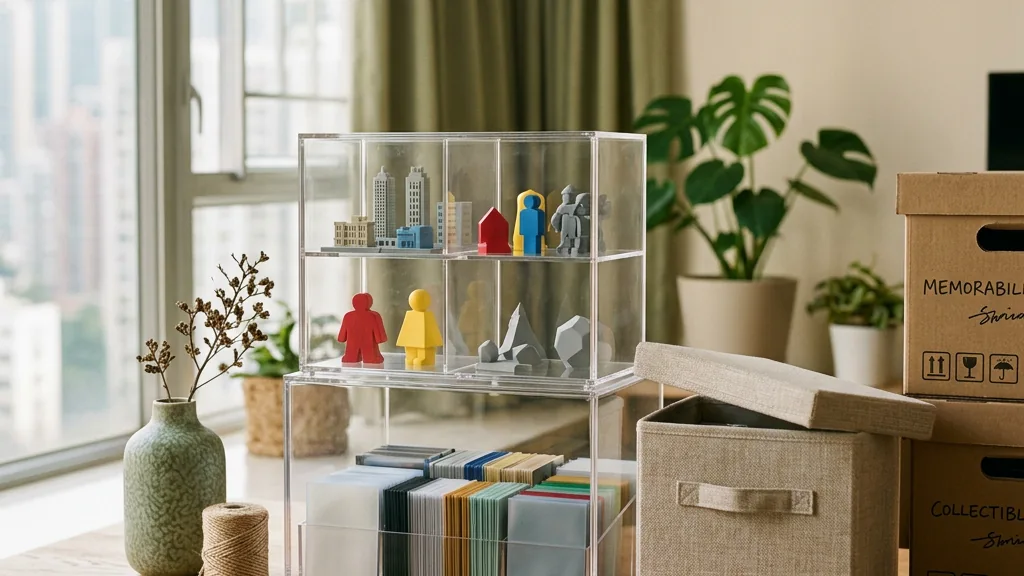
Foil cards consist of layered materials that react differently to environmental humidity, causing warping due to imbalanced stress. It is recommended to store cards in stable environments using appropriate airtight packaging and classification methods to minimize the risk of deformation.
After opening a box and pulling your dream rare foil card (such as Charizard SAR, Lillie, or a classic first edition), every Hong Kong collector of Pokemon, Yu-Gi-Oh!, or One Piece cards likely carefully sleeves it and puts it into an album for safekeeping. However, once autumn/winter comes, or after a few days of air conditioning, you open your card box only to find that your once-flat and straight expensive foil cards have unexpectedly curled upward or backward, bending into a 'miniature potato chip'!
Looking at your beloved high-value collection deformed, many players feel heartbroken and panicked: curled cards may be judged as marked cards in official tournaments, and sending them for PSA or BGS grading might result in deductions for quality, causing their value to evaporate by a significant percentage or even tens of thousands of dollars. Why do cards bend like potato chips when the weather turns dry?
How should collectors properly protect against moisture and dryness?
A tens of thousands of dollars Charizard bent into a potato chip? A direct look at the devaluation crisis of foil card curling during the autumn/winter seasonal change
Many Hong Kong card beginners often think that 'cards are most afraid of humidity', believing that keeping them in a dry environment is foolproof, only to be awakened by the arrival of winter. Hong Kong's autumn/winter season often features dry northeast monsoons, with indoor relative humidity frequently plummeting from 80-90% in summer to 40% or even lower; plus, many families are accustomed to using heaters or living in enclosed, air-conditioned environments, leading to rapid loss of moisture in the air.
When you excitedly take out your treasured cards for appreciation or submission, you are shocked to find that your once-straight foil cards have developed serious 'C-curls' or even 'wavy distortions'. In the secondary card market, condition is everything. Once a card has a visible arc, not only is it difficult to put into tight sleeves, but when sent to authoritative agencies for appraisal, graders often strictly evaluate the flatness and structural tension of the card surface, causing a card that could have potentially achieved a Gem Mint 10 to fall to an 8 or 9, leading to an immediate collapse in collection value and resale price.
This asset shrinkage caused by sudden humidity changes is a nightmare that keeps countless collectors awake at night.
Why don't normal cards bend while foil cards do? Deconstructing the physical truth of paper shrinkage and metallic foil layers
Why is it that in the same box of cards, common (non-foil) cards remain flat even after a year, while the most precious foil (foil) cards bend so dramatically? This involves the classic 'bimetallic strip effect' in materials science. Common cards are pressed from simple wood pulp fibers, and their overall expansion coefficient for moisture absorption and release is relatively uniform; however, modern high-end foil cards belong to composite laminated materials: the bottom layer is a thick paper base, while the surface is composed of an extremely thin layer of metallic reflective foil or plastic holographic coating.
These two materials have fundamental conflicts in their physical response to environmental humidity. The underlying paper fibers have strong 'hydrophilicity', absorbing water and expanding when environmental humidity is high, and rapidly dehydrating and shrinking when the environment is dry; conversely, the metallic foil layer on the surface is a non-porous inorganic substance, through which moisture cannot penetrate, and its size remains almost unchanged at room temperature.
When the autumn/winter weather turns dry, the paper base loses moisture, causing its area to shrink slightly, but the metallic foil surface remains as it is. Under uneven stress, the edges are forced to shrink and pull toward the back of the paper side, forming an outward or inward arching potato chip shape.
If a card exhibits warping, it is recommended to place it in a stable, dry environment with appropriate cushioning, avoiding forceful bending. For significant damage, seek help from professional preservationists; do not use heat, irons, or aggressive chemical desiccant products to avoid irreversible harm.
When encountering slightly bent cards, you can safely implement the following step-by-step emergency procedure: First is 'two-way humidity-controlled microclimate balancing'. Do not forcefully fold dry, bent cards in the opposite direction. Prepare a crisper box with a rubber seal and place a properly packaged '60% or 62% two-way humidity-control pack' inside.
Leave the cards either raw or in open-end sleeves for 24 to 48 hours to allow the paper fibers to naturally absorb trace amounts of moisture in a constant humidity environment, releasing the tensile stress of the internal metallic film; second is 'gentle and even flattening'. After the cards have naturally softened from absorbing moderate moisture, put them into brand-new flat micro-inner sleeves, and clamp them between two flat, transparent acrylic plates, placing one or two light books on top to apply even pressure for 12 hours.
However, do not use a home hair dryer for direct blowing or iron them at low temperature, as high heat will damage the foil film adhesive, causing bubbling and whitening; also, do not use single-way strong desiccants close to the cards, as excessive drying will cause the paper fibers to become brittle and even lead to cracking or creases.
Comparison of various card protective accessories and storage environments: Which protection can best withstand humidity fluctuations?
There are many types of protective products for cards on the market, and the blocking ability and humidity-control performance of different accessories vary. To help Hong Kong collectors have a better sense of direction when managing their cards, we have organized a detailed comparison list of common card protection methods to help you accurately assess which strategy best suits your actual needs:
Card protection and storage method 🎴 | Temperature/humidity control and anti-bending principle 💡 | Common limitations and potential risks ⚠️ | Professional advice strategy from our mini-storage team ✅ |
Ordinary binder with thin single-layer sleeves | Convenient for browsing, affordable, easy to organize | The opening is directly connected to the outside air, completely unable to block moisture gain or loss | Only suitable for low-value common cards; expensive foil cards are extremely easy to deform |
Double sleeves with magnetic hard case | Polycarbonate hard shell is pressure-resistant and scratch-resistant, with a textured appearance | The edge is not completely vacuum-sealed; it will still slowly bend under pressure when exposed to dry and cold conditions for years | Highly recommended for daily display; requires coordination with external humidity control |
Sealed dry box with two-way humidity pack | Airtight container locks in the microclimate, maintaining the golden 60% humidity | Requires checking and replacing humidity packs every few months; capacity is relatively limited | Suitable for household humidity-controlled emergency care for dozens to hundreds of high-value cards |
All-weather constant temperature and humidity professional storage | Maintains constant temperature and 50%-60% humidity 24/7, preventing thermal expansion and contraction | Requires payment for the corresponding exclusive storage space rent | Strongly recommended for large collections, sealed original boxes, and long-term value preservation |
Through the table above, it is clear that relying solely on sleeves or hard shells can only prevent scratches and collisions, but cannot withstand material deformation caused by moisture entering and leaving; combining physical hard shell protection with stable environmental humidity control is the key to preventing foil cards from bending like potato chips.
Seeking professional team help
Although you have learned daily self-inspection protection techniques such as two-way humidity packs, acrylic light pressure, and moisture-proof crisper boxes, which can cope with the deformation repair of a small number of cards, when your private card collection scale gradually expands to dozens of albums and thousands of unopened original boxes and cartons, ordinary Hong Kong home environments are often unable to provide ideal storage conditions.
Living spaces in Hong Kong are generally small and narrow, with humidity as high as 90% or more in spring causing moisture and mold, while in autumn and winter, indoor air can easily drop to cracking levels due to air conditioning and dry weather; if you keep large dehumidifiers or humidifiers on at home, it is not only amazingly power-consuming, but you also have to worry about checking if the water tank is full every day.
If you go on a business trip for a few days, the drastic fluctuation in environmental temperature and humidity will cause your treasured cards to suffer again. Instead of worrying every day about hundreds of deformed cards and fearing that valuable treasures will lose their grading value, why not entrust your precious card assets to our professional mini-storage team?
We help you properly store every box of beloved collections, fully releasing your home space and allowing your cards to remain as straight as new with perfect luster whenever you open them for appreciation.
FAQ
Q1: Will Pokemon foil cards that are bent like potato chips be deducted points when sent to PSA or BGS for grading?
A1: There will be a considerable negative impact. Although graders mainly inspect corners, edges, centering, and surface, severe bending affects the fit of the card in the encapsulation case, and the tension generated by bending can easily lead to microscopic silver line cracks in the card surface coating, which are easily judged as surface flaws, resulting in downgrading.
Q2: What is the safest humidity setting when using a household electronic dry cabinet to store cards?
A2: Do not set the humidity too low for paper cards like you would for camera lenses! Camera lenses usually need around 40% to prevent mold, but if cards are kept in an environment below 45%, the paper fibers will shrink excessively, leading to severe reverse bending; it is recommended to set the dry cabinet humidity precisely between 50% and 55% for the best results.
Q3: Why do foil cards that have been put into thick hard card holders still bend after a winter?
A3: Because normal top-loaders are open at the top, and the sides are not vacuum-sealed. When the surrounding air becomes dry, dry air still seeps in through the gaps to extract moisture from the back of the card; if you want to completely block it, you need to use a special waterproof and airtight sealed zipper bag or card slab for double isolation after putting them in tight inner sleeves.
One Plus One Storage Services
One Plus One Storage provides professional mini-storage services, dedicated to providing citizens with flexible, convenient, and reasonably priced storage solutions. We have an in-depth understanding of the problems of land supply shortages in Hong Kong's urbanization process, as well as the current situation where changes in working patterns have led to an increasing demand for home space by citizens. Therefore, we created One Plus One Storage to respond to these growing needs.
Our mini-storage units cover a variety of sizes. Whether clients need small storage spaces for personal items or large storage spaces for storing company documents or furniture, we can provide suitable solutions. In addition, our pricing is fair and transparent, and we provide flexible lease terms. Whether it is a long-term or short-term lease, clients can flexibly choose according to their own needs.
Welcome to get a quote or inquire: Click to contact us via WhatsApp
- Address: Room 16-17, 9/F, Nan Fung Commercial Centre, 19 Lam Lok Street, Kowloon Bay
- Phone: 3188 1889
- WhatsApp: 6928 9628
- Email:enquiry@opostorage.com
Feel free to contact us anytime, let us provide you with professional mini-storage
"
Practical storage and planning
- Place precious cards into archival-grade, acid-free protective sleeves for initial shielding.
- Store cards in a well-sealed container to insulate them from significant environmental humidity fluctuations.
- For cards that have already deformed, consult professional preservation or restoration services rather than attempting DIY repairs.
Frequently asked questions
Does card warping affect grading scores?
Significant warping can affect the fit of the card within a protective case and may stress the card surface structure, potentially impacting the final condition assessment.
What is the best environment for long-term card storage?
Avoid areas with extreme or fluctuating humidity levels. A stable, well-ventilated, and climate-controlled environment is ideal, and professional storage solutions may be considered for large collections.
Further reading: US National Archives guidance on storing papers and photographs; Canadian Conservation Institute guidance by material