
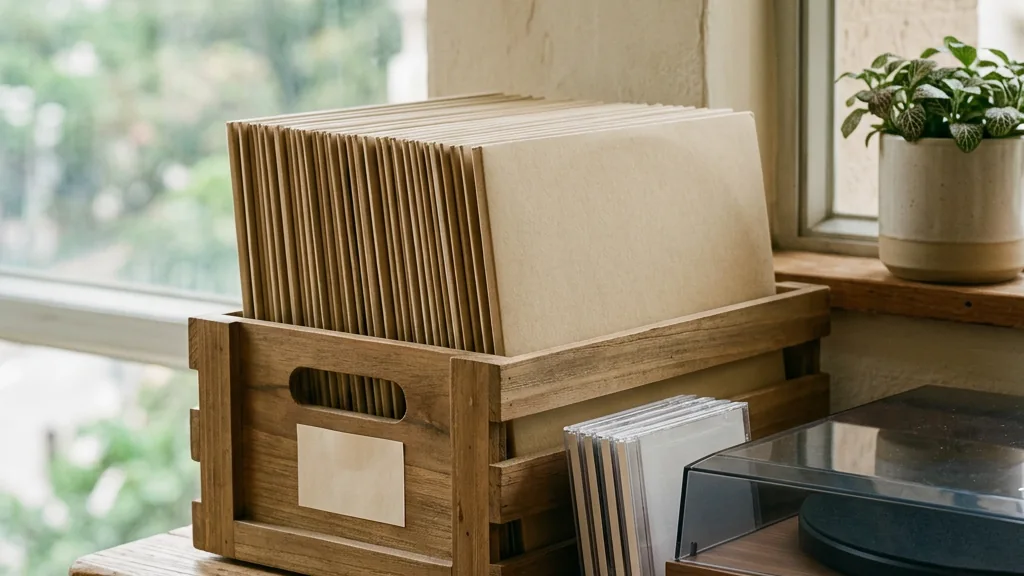
Vinyl records should always be stored vertically, never stacked horizontally. Vertical storage allows gravity to distribute weight evenly along the outer edges, preventing potential damage to the grooves.
To be a music enthusiast or vinyl collector in Hong Kong, from hunting for classic first editions of Leslie Cheung or Beyond at Mong Kok's Sin Tat Plaza or Sham Shui Po's Apliu Street, to ordering limited-edition colored vinyl from overseas, every vinyl record carries irreplaceable analog sound quality and nostalgia. However, living space in Hong Kong is at a premium, with limited room in the living room and study.
Many friends who bought dozens or even hundreds of vinyl records home, lacking dedicated record cabinets, have developed the habit of stacking them "neatly" one by one like magazines, tucked under TV stands or beds. To their surprise, after a few months, when they take them out to play on a turntable, the stylus jumps violently up and down upon landing, and the headphones transmit obvious distorted micro-sounds or even direct "skipping"!
Looking at your beloved collection showing visible edge warping, the heartache is indescribable. Should vinyl records be stored vertically or horizontally? How does the difference in gravitational stress silently destroy the lifespan of a record?
Does a stack of beloved vinyl skip when played? Deconstructing the tragedy caused by horizontal stacking pressure
Horizontal stacking can lead to uneven pressure on vinyl records. Storing them vertically is recommended to protect the structural integrity of the grooves.
Why does vertical storage evenly release pressure? Deconstructing the truth about gravity-induced deformation of polyvinyl chloride
Vinyl materials can be affected by their environment; vertical storage ensures the record's own weight is distributed evenly to avoid groove compression.
How to prevent collapse when organizing on a bookshelf at home?
Records should be kept strictly vertical during storage to avoid leaning. For collections where environmental conditions are hard to maintain, professional assistance is advised.
Vinyl Storage Methods and Environments Comparison: Which process best protects sound quality?
There are many types of vinyl storage tools and environments on the market, and different processes vary in stress distribution, anti-warping performance, and groove protection. To give every Hong Kong vinyl enthusiast more direction when planning space for their collection, the following is a detailed comparison list of common storage methods to help you accurately evaluate which strategy is most appropriate:
Record storage method and environment 🎵 | Physical stress characteristics and main advantages 💡 | Common limitations and potential hazards ⚠️ | One Plus One Storage team suggested strategies ✅ |
Horizontal multi-stack storage | Saves time for initial organization, can be stacked randomly on flat surfaces | The bottom bears immense pressure, very prone to permanent wavy warping | Highly discouraged; it is the main culprit for destroying vinyl grooves |
Overly loose, significantly tilted vertical storage | Easier to flip through records, casual appearance | The center of gravity is skewed to one side, generating continuous bending torque, inducing chronic deformation | Must install metal baffles or thick bookends to maintain vertical standing |
Vertical ninety-degree cabinet storage | Records bear stress vertically and evenly, zero squeezing on grooves | Requires special deep-dimension record cabinets, taking up home space | Highly recommended as the standard storage method for daily listening at home |
All-weather climate-controlled professional storage | Maintains low temperature and dryness 24/7, prevents heat deformation and mold spots | Requires paying rental expenses for dedicated storage space | Suitable for long-term preservation of a large number of rare first editions and high-value vinyl |
Through the table above, it can be clearly seen that maintaining a ninety-degree vertical stance is the basic physical bottom line for protecting the record structure, and a stable, dry, light-shielded, climate-controlled environment is the core key to keeping classic recordings timeless.
Seeking professional team help
Although you have mastered DIY techniques such as vertical storage, using acid-free anti-static inner sleeves, and avoiding significant tilting, when a private vinyl collection accumulates to hundreds or even thousands of records, Hong Kong's space-constrained living environment often cannot provide ideal preservation conditions. Vinyl records are large and heavy, and a whole cabinet of records can easily weigh hundreds of pounds; ordinary home thin-layer shelves can easily sag and deform under pressure.
Furthermore, Hong Kong's hot and humid spring and summer seasons last for more than half a year. If you cannot run air conditioning and dehumidifiers 24/7, dramatic fluctuations in temperature and humidity can easily cause PVC material creep and warping, and outer paper sleeves can also become damp, yellow, and develop mold spots, causing a significant loss in the value of the collection.
Instead of worrying every day about your vinyl records being compressed and deformed, or letting numerous record boxes occupy precious living space, why not entrust the preservation of your precious vinyl to our professional storage team? We help you properly place every beloved classic, completely freeing up home space, allowing your precious vinyl to keep the sound of time and be passed down for a long time.
Frequently Asked Questions
Q1: Can slightly warped vinyl records be pressed flat with heavy books?
A1: This is not recommended. Simply pressing with heavy objects at room temperature often fails to smooth out PVC records that have undergone molecular deformation, and can easily crush the delicate grooves on the surface. While there are professional vinyl flattening machines, temperature control needs to be extremely precise, and the slightest deviation will melt the grooves. Therefore, preventing warping is much safer than repairing it after the fact.
Q2: When vinyl records are stored vertically, how many per shelf compartment is ideal?
A2: For a standard 12-inch vinyl record cabinet (about 33 cm deep), it is recommended to keep each compartment width around 30 to 35 cm, with 50 to 60 records being the most moderate. The overall tightness should be kept so that the palm can be easily inserted to pull them out, avoiding side pressure caused by being too tight, and avoiding tilting to the side caused by being too loose.
Q3: Why are humidity requirements for vinyl storage environments so strict?
A3: Because excessive humidity (over 70%) causes paper inner and outer sleeves to mold, and mold hyphae penetrating into the groove grooves will produce difficult-to-remove popping noises; while being too dry (below 40%) will generate a large amount of static electricity, which easily attracts fine, hard dust particles in the air, scratching the record surface.
One Plus One Storage Services
One Plus One Storage provides professional storage services, dedicated to offering citizens flexible, convenient, and reasonably priced storage solutions. We deeply understand the issue of land supply shortages in Hong Kong's urbanization process, as well as the current situation where changing work patterns have led to an increasing demand for home space among citizens. Therefore, we founded One Plus One Storage to respond to these growing needs.
Our storage facilities cover a variety of sizes; whether customers need small storage spaces to store personal items, or large storage spaces to store company documents or furniture, we can provide suitable solutions. In addition, our pricing is fair and transparent, and we provide flexible lease terms; whether for long-term or short-term rentals, we allow customers to choose flexibly based on their own needs.
Welcome to request a quote or inquire: Click to contact us via WhatsApp
- Address: Room 16-17, 9/F, Nan Fung Commercial Centre, 19 Lam Lok Street, Kowloon Bay
- Phone: 3188 1889
- WhatsApp: 6928 9628
- Email:enquiry@opostorage.com
Feel free to contact us at any time, let us provide you with professional storage
Practical storage and planning
- Maintain records in a strictly vertical position and use sturdy bookends to prevent leaning.
- Use acid-free, anti-static inner and outer sleeves to provide a layer of protection against dust.
- Store valuable or large collections in a professional climate-controlled facility to ensure long-term stability.
Frequently asked questions
Can I flatten slightly warped records by placing heavy books on them?
We do not recommend DIY pressure methods. Applying weight or heat often fails to correct deformation and can easily damage the delicate grooves; please consult a professional conservator.
How tightly should records be packed when stored vertically?
Keep the density moderate so your hand can easily slide a record out; packing too tightly causes side pressure, while too loose leads to leaning.
Further reading: US National Archives guidance on storing papers and photographs; Canadian Conservation Institute guidance by material