
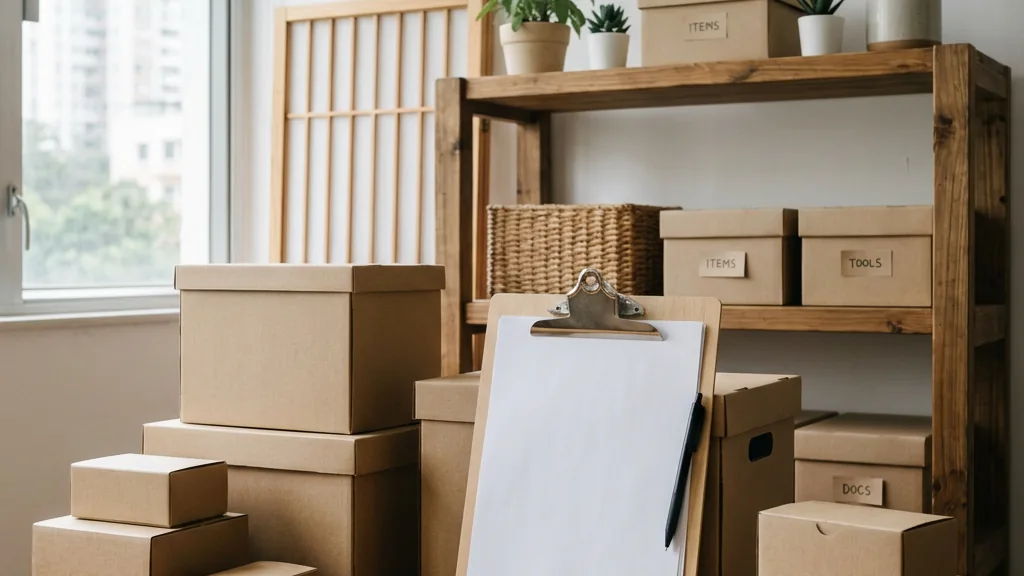
Utilize vertical space by organizing items with heavy goods at the bottom and lighter ones on top. Implementing sturdy shelving improves stability and efficiency.
In Hong Kong, whether you are renting a place or doing business, space is always the most luxurious resource. Many times, because there are too many miscellaneous items at home or the company and you cannot stand the rent pressure, you have to rent a storage unit to store suitcases, seasonal clothing, or company stock. However, when you have signed the contract and opened the storage unit, you often find a cruel reality: clearly the size you rented is not that big, but if you only stack all miscellaneous items one on top of another flat on the floor, not only will you use up the space very quickly, but you will also be forced to upgrade to rent a larger unit, causing your wallet to bleed every month.
Facing the pressure of rising rents, how can you 'develop upwards' within the storage unit within a limited budget and truly utilize every inch of height?
Why Are Small Units Always Not Enough? Deconstructing the Monetary Waste of Flat Stacking
Many people, when using storage units, are accustomed to the mindset of tidying up at home, laying cardboard boxes of various sizes directly flat on the floor of the unit. This seemingly logical way of placement actually hides great spatial waste. Floor area is limited, and when you lay boxes to cover the floor horizontally, you will find that the space is instantly used up, to the point that there are no aisles to walk in and retrieve items.
Even worse, in order to store a few more items, you have to pay hundreds or even thousands of dollars more every month to rent a larger unit. This practice of focusing only on floor area and ignoring vertical height invisibly causes huge monetary waste. In Hong Kong, where every inch of land is worth gold, every cubic foot of height in a storage unit is bought with real money.
If you do not know how to develop towards high altitude, it is equal to wasting precious three-dimensional space for nothing.
Why Does Blind Stacking Become a Disaster? Unraveling the Physical Blind Spots of Vertical Storage
Stacking cardboard boxes blindly can lead to structural collapse. If items are in poor condition or damaged, consult a professional conservator instead of attempting DIY repairs to avoid further harm.
How to Utilize High-Altitude Space? Comparison of Shelving and Storage Box Configuration Schemes
To let tenants use the best budget to exert maximum spatial benefits in the storage unit, we have organized common vertical storage schemes into the following comparison table:
Vertical Storage Scheme 🔍 | Space Utilization & Load-bearing Performance ⚠️ | Flexibility & Cost Consideration ✨ |
Modular Metal Heavy-duty Shelving | Utilize three-dimensional height to build multi-layer structures, significantly increasing storage capacity, extremely high load-bearing force | Requires extra assembly and fixed costs are higher, suitable for long-term large quantity storage |
Transparent Industrial Style Plastic Box Stacking | Through hard plastic boxes of unified specifications locked together, stability is better when stacked high | Height is limited by single-box load-bearing, there is still risk of tilting if stacked too high |
Blindly Stacking Traditional Cardboard Boxes | Cost is extremely low and easily available, almost no extra cost required initially | Cardboard boxes lack long-term structural stability when stacked high, are not recommended for vertical storage, and make content identification difficult. |
Through the comparison of the table above, you can see that making good use of stable shelving or modular hard plastic boxes is far safer and more efficient than blindly stacking old cardboard boxes.
How to Plan to Save the Most Space? Actual Combat Steps for High-altitude Storage and Safe Retrieval
After mastering the concept of vertical development, as long as you follow scientific steps to layout, you can release amazing storage potential in the storage unit. The following breaks down the standard actual combat storage process for everyone:
💡 Step 1: Precisely Measure Storage Unit Height and Divide Areas
Operation: Before moving items into the storage unit, first measure the actual usable net height inside the unit, and divide the space into low, medium, and high levels.
Verification method: Ensure that the bottom layer stores heavy and rarely used items, the middle layer stores frequently used items, and the top layer stores lightweight seasonal items.
💡 Step 2: Introduce Modular Metal Shelving to Build a Vertical Structure
Operation: Purchase modular metal shelving that meets height specifications, separating the three-dimensional space into multiple layers, avoiding weight pressing directly on the bottom boxes.
Verification method: Check if the shelving is installed firmly and level, ensuring that every layer can evenly bear corresponding weight.
💡 Step 3: Uniformly Replace with Transparent Storage Boxes and Label Them Well
Operation: Uniformly store miscellaneous items in transparent hard plastic boxes, and stick clear, large-character labels on the outside of the boxes, convenient to identify contents without needing to move them.
Verification method: Spot-check whether you can see the inside items at a glance when retrieving top-layer boxes, confirming that retrieval will not damage the overall structure.
Seeking Help from a Professional Team
When you have tried various ways of developing upwards but find that the items inside the storage unit are too messy, heavy shelving is difficult to assemble, or you worry that improper space planning leads to rent waste, instead of having a headache about tidying up every day, you might as well hand the professional space planning and storage management work to a professional team in the related field.
As a storage unit team that deeply understands the storage pain points in Hong Kong, we possess rich space optimization experience, flexible storage size choices, and professional storage consultation services, able to tailor the most efficient vertical storage solution for you. When you hope to make the storage unit space exert to the extreme, and handle all miscellaneous storage problems with the most cost-effective budget, seeking professional support can make the whole process twice the result with half the effort, helping you easily realize efficient storage.
Common Questions (FAQ)
Q1: Does using metal shelving to develop upwards inside a storage unit violate the storage unit's management regulations?
A: Generally, compliant storage units allow tenants to place self-assembled movable shelving that does not damage walls and floors. However, for the sake of safety, the shelving height should not exceed the safety height of the fire sprinkler system (it is suggested to reserve appropriate space from fire sprinklers). It is recommended to query and confirm with storage unit staff before renting.
Q2: If I don't want to spend money to buy metal shelving, are there any cheap ways to achieve vertical storage?
A: You can choose to purchase hard industrial-style storage boxes with unified specifications and slot designs at the bottom. This type of plastic box itself possesses good pressure resistance and does not slide easily when stacked on top of each other, but the stacking height is suggested to be controlled within three to four layers to prevent it from being top-heavy and causing tilting.
Q3: Does placing heavy items on the high layers of shelving create safety hazards?
A: There are indeed major hazards. When planning vertical storage, you must follow the golden principle of 'heavy at the bottom, light at the top', placing heavy books or electrical appliances on the bottom layer or floor, frequently used items on the middle layer, and lightweight quilts, pillows, or seasonal clothing on the high layers, so that you can ensure structural stability and personal safety when retrieving items.
One Plus One Storage Services
One Plus One Storage provides professional storage services, dedicated to offering citizens flexible, convenient, and reasonably priced storage solutions. We deeply understand the issue of land supply shortages in Hong Kong's urbanization process and the current situation where changing work patterns lead to an increasing need for home space among citizens. Therefore, we pioneered One Plus One Storage to respond to these growing needs.
Our storage units come in a variety of sizes; whether customers need small storage space to house personal items or large storage space to store company documents or furniture, we can provide suitable solutions. Furthermore, our pricing is fair and transparent, and we provide flexible lease terms—whether for long-term or short-term, customers can flexibly choose based on their own needs.
Welcome to request a quote or inquiry: Click to contact us via WhatsApp
- Address: Units 16-17, 9/F, Nan Fung Commercial Centre, 19 Lam Lok Street, Kowloon Bay
- Tel: 3188 1889
- WhatsApp: 6928 9628
- Email:enquiry@opostorage.com
Welcome to contact us anytime, let us provide you with professional storage services
Practical storage and planning
- Measure the usable unit height and divide the space into low, medium, and high levels.
- Install modular metal shelving to create a stable vertical structure for your items.
- Use durable, uniform storage containers with clear labels for easy identification and retrieval.
Frequently asked questions
What should I consider when adding metal shelving?
Ensure the shelving is stable and does not damage unit walls or floors, while keeping clearance from fire sprinklers.
How should I handle items that appear damaged?
If items show signs of deterioration or damage, consult a professional conservator rather than attempting repairs yourself.
Further reading: US National Archives guidance on storing papers and photographs; Canadian Conservation Institute guidance by material