
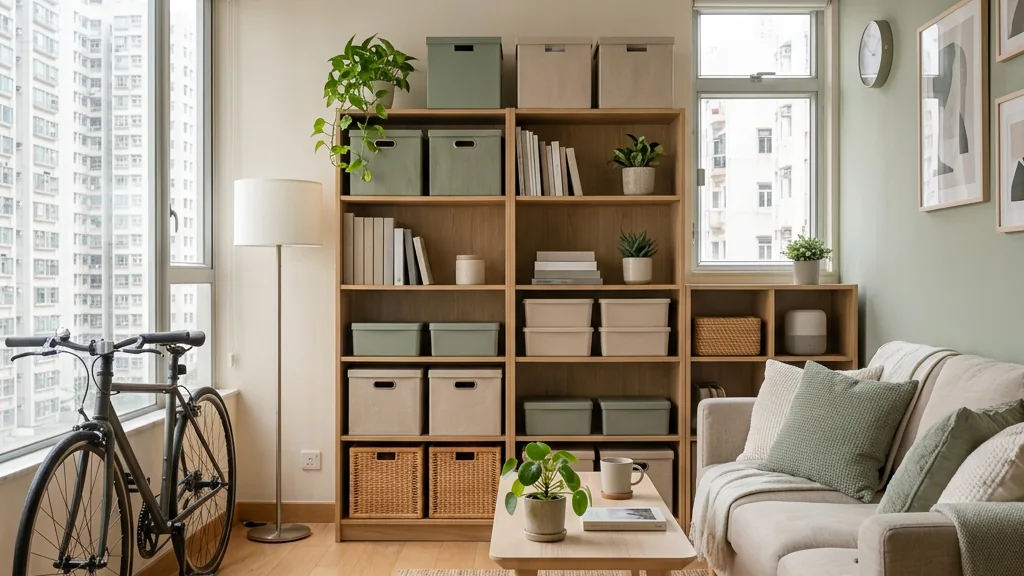
Organize your prop room by screening for active items and categorizing them based on usage frequency and material. Use clear bins and an index for easy tracking. For excessive volumes or specialized items, consult professional storage or conservation experts.
As a freelancer—whether you are a photographer, stylist, creator, or content manager—there is almost always a "prop room" in your home or studio for storing props, samples, equipment, and packaging materials. Initially, this space is full of inspiration, but as you take on more projects, it can become a "black hole" where you go in but cannot come out—spending half an hour digging through boxes to find a prop you bought six months ago, or even buying duplicates because you can't find things. Breaking this vicious cycle doesn't require renovation; it just needs a minimalist simplification storage technique designed for freelancers. Here are four core steps to help restore efficiency and order to your prop room.
Step 1: Cruel "Functional Decluttering"
Props are different from daily clutter; their defining characteristic is "better to have it and not need it than to need it and not have it." This is why prop rooms easily become overcrowded.
Audit every prop, consider whether it has been used recently, and assess its ongoing practical value for your upcoming work projects.
Decisive Decluttering: If the answer to both is "no," or if it is just "I think it's beautiful but will never use it," please be brave enough to resell, donate, or give it to peers who might need it. The value of a prop lies in it "being seen and used," not gathering dust in a box.
Step 2: Modular Zoning by Category
Throwing props haphazardly into a large box is the root cause of clutter. You must establish a clear classification logic, similar to a library or warehouse:
Layering by "Usage Frequency": Place high-frequency core props used weekly (e.g., basic backdrops, common small LED lights) on the middle shelves within eye level and easy reach; store seasonal or once-a-year items (e.g., Christmas decorations, special festival props) in high or deep storage.
Packing by "Material and Property":
Small items (ribbons, candles, dried flowers, tableware): Use transparent drawer-style storage boxes or labeled sorting boxes to see contents at a glance.
Large fabrics and backdrop paper: Roll them up uniformly and store them in dedicated long tubes or vertical umbrella stands to avoid creases.
Cables and small equipment: Use velcro ties to bundle them neatly and place them in partitioned toolboxes.
Step 3: Visual Labeling—Say Goodbye to Blind Searching
"Memory is unreliable; labels are your most efficient partner."
Transparency and Labeling: Choose transparent storage boxes whenever possible. If using opaque boxes, be sure to attach clear labels on the front and sides (e.g., "#01-Tabletop tableware," "#02-Autumn/Winter knit fabrics").
Create a "Digital Prop Inventory": For expensive or large-quantity props, use your phone's memo app or a simple spreadsheet to create an index. When taking on a new project, searching on your phone saves time compared to digging through boxes on site.
Step 4: Establish a "Daily Maintenance" Habit
After organizing the space, the hardest part is maintaining it. Freelancers must establish micro-habits for the prop room:
The "Golden 5 Minutes" for Putting Things Back: After a long day of shooting, you often want to throw props aside. Force yourself to spend 5 minutes cleaning the day's items and returning them to their place; never let clutter sit overnight.
Set up a "Middle Station for Sorting": Place a dedicated "To-be-Sorted" basket by the door or in a corner. If you are truly exhausted, at least put the messy items in this basket to keep the studio pathway clear and prevent the chaos from spreading like a virus to the entire space.
Seeking Professional Assistance
If a large project has left your studio in disarray or if the volume of props is overwhelming, managing it yourself may result in damage. We recommend seeking assistance from professional storage services or relevant conservation specialists to ensure your items and space are handled safely.
One Plus One Storage Services
One Plus One Storage provides professional storage services, committed to offering flexible, convenient, and reasonably priced storage solutions to the public. We deeply understand the issues of land scarcity in Hong Kong's urbanization process, and how changing work modes have increased the demand for home space. Therefore, we founded One Plus One Storage to respond to these growing needs.
Our storage units come in various sizes; whether customers need small spaces for personal items or large spaces for company files or furniture, we offer suitable solutions. Furthermore, our pricing is fair and transparent, with flexible rental terms for both long and short-term needs.
For quotes or inquiries: Click here to contact us via WhatsApp
- Address: Units 16-17, 9/F, Nam Fung Centre, 19 Lam Lok Street, Kowloon Bay
- Phone: 3188 1889
- WhatsApp: 6928 9628
- Email:enquiry@opostorage.com
Feel free to contact us, and let us provide you with professional storage solutions.
Practical storage and planning
- Audit your current prop stock and evaluate if items align with your upcoming project needs.
- Categorize props by frequency and material, placing them into appropriate storage containers.
- Maintain an inventory list for quick access and commit to a consistent return-to-storage routine.
Frequently asked questions
What should I do if the volume of props exceeds my storage capacity?
Prioritize keeping the most essential, high-frequency items and consider off-site professional storage solutions for secondary props to keep your primary workspace clear.
How can I assess if an item is damaged or should no longer be kept?
Evaluate items for structural integrity and functionality. If a piece is significantly damaged or fragile, contact professional restorers or conservationists to ensure appropriate care.
Further reading: US National Archives guidance on storing papers and photographs