
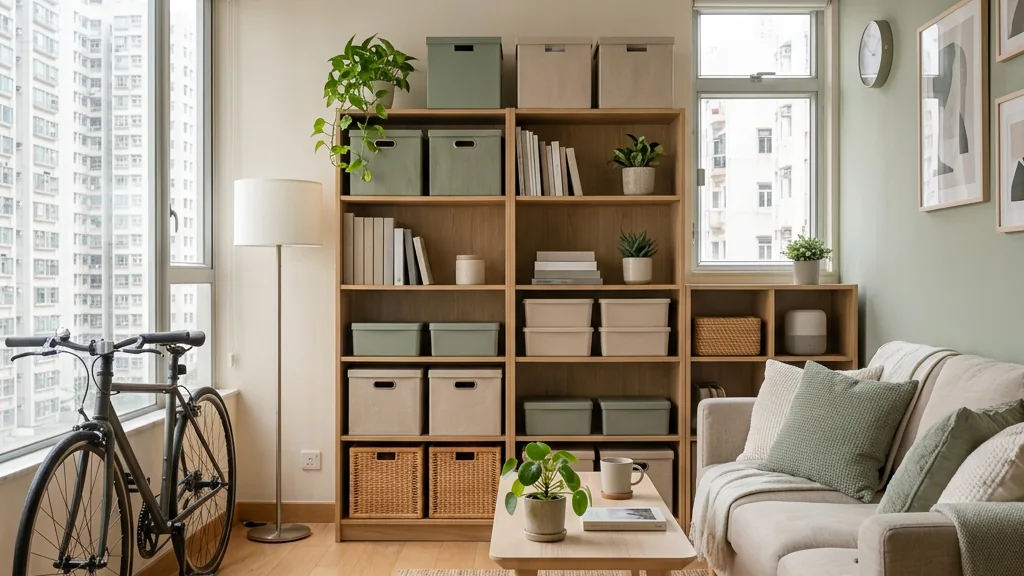
For long-term stored items, conduct regular inventories and categorize them as keep, donate, or discard. Consult professionals for valuable or damaged items to ensure safe handling and avoid damage.
Paying hundreds or even over a thousand dollars a month for mini storage, filled with cardboard boxes and large clutter moved in during a move or seasonal change three or five years ago. Life is busy, and few go to open the storage, and even forgotten what is inside. Until receiving renewal bills every year or seeing statement deductions, feeling a sudden tightness in the chest: "Do I really still need this pile of stuff?" In Hong Kong, a city with serious land problems, many people think that just stuffing clutter into mini storage equals solving spatial worries, but ignore that long-term idle items not only silently erode your wallet but also kidnap your mental space. For items that haven't been touched for years, how to judge calmly whether they should be ruthlessly decluttered?
Are units left unopened for years just trash? Dismantling the accumulation psychology and invisible rental burdens
For items that have remained in storage for years, we recommend periodically checking their physical condition. If items are no longer needed or are in poor condition, consider donating or recycling them to optimize storage space. For sensitive or valuable belongings, please consult a professional conservator for proper assessment and preservation guidance.
Knowing it's useless but still reluctant to throw away? Exploring emotional attachment and the myth of "might be useful later"
Talking about actually throwing away or donating items in the storage that haven't been touched for years, many people will immediately have a sense of unexplained guilt and fear. "Although this jacket hasn't been worn for years, the fabric is beautiful; what if I fit into it after losing weight?" or "Although this old camera is broken, it's a memory!" This psychological phenomenon is called emotional attachment and "loss aversion" in behavioral science.
The pace of life in Hong Kong is fast, and work pressure is high; sometimes we project anxiety about beautiful moments in the past or uncertainty about the future onto these materials. We are always used to comforting ourselves with "might be useful later," resulting in mini storage becoming a sanctuary for hoarding regrets and fears. To break this myth, we must learn to separate the "practical value of items" from "the memory itself"; memories can stay in the brain or photos, and do not need to be maintained by several boxes of dusty old items.
Practical four-step filtering method for decluttering: How to objectively judge the real residual value of an item?
Faced with a storage full of items that haven't been touched for years, without a clear filtering logic, it's easy to fall into the dead end of "reluctant to part with everything." At this time, you might want to try using a practical four-step filtering method to question yourself. The first step is the "time frequency method," ask yourself if you have actively thought about it in the past twelve months?
If not, it proves that it has completely lost its existence in your life. The second step is the "replacement cost method," assuming you suddenly need to use it today, is the cost of buying a new one cheaper than continuing to pay storage rent for years? The third step is "emotional purity," ask yourself with your hand on your heart if this object brings you present joy or heavy guilt?
The fourth step is "status adaptability," does it still fit your current life stage and aesthetic taste. Through these four dimensions of peeling the cocoon, you can rationally filter out the core items that are truly worth keeping, and the rest can be let go of with peace of mind.
Blindly decluttering by yourself or periodic reviews? Comparison table of self-decluttering versus professional storage organizing
When you make up your mind to deal with long-term idle storage, should you spend a few days on the weekend slowly organizing it yourself, or seek professional help? In order for everyone to clearly grasp the differences between different treatment methods, we have compiled the core differences into the following practical comparison table to help everyone weigh the actual results:
Decluttering and Storage Dimension 🔍 | Blindly decluttering by yourself on weekends ✨ | Professional mini storage team guidance assistance 💡 |
Decision-making efficiency and psychological pressure ⏱️ | Faced with a full storage of clutter, it's easy to hesitate, consuming a lot of energy but progressing slowly | Objective assistance in classification and assessment, efficiently clarifying the essence that really needs to be retained |
Spatial cost and rental efficiency 💰 | Reluctant to discard, leading to continuing to rent too large a storage unit, long-term payment of wasted rent | Precisely adjusting the size of the storage unit, helping you effectively save unnecessary long-term expenses |
Subsequent item handling and donation ♻️ | Old items cleared out pile up at home, not knowing how to handle them, causing secondary trouble | Providing practical donation, recycling, or precise reorganization suggestions, making the process time-saving and worry-free |
Seeking help from a professional team
When you are faced with piles of cardboard boxes accumulated in mini storage that have never been opened for years, feel unable to start, don't know how to choose, or feel a headache for expensive rent and messy space every time you open the storage, instead of struggling and sighing alone in a narrow storage unit, why not hand over this heavy space inspection and storage optimization task to our professional mini storage team?
We have years of experience in local storage space management, customer storage consultation, and spatial planning in Hong Kong, and deeply understand the psychological struggle and spatial pain points of Hong Kong people when facing long-term idle items. Through professional field assessment, transparent rental benefit analysis, and caring spatial configuration suggestions, we assist you in re-examining the real value of every inch of storage space, saying goodbye to unnecessary accumulation anxiety, and helping you release the burden on your wallet and mind.
When you want to have a truly fresh decluttering for your life, our professional support can help you easily solve all storage problems.
FAQ
Q1: If items have been in mini storage for years without being moved, does it mean they can basically be thrown away?
A: Not all need to be thrown away. Although long-term stillness reflects its very low frequency of use, it is still necessary to distinguish between items with very strong seasonality (such as thick winter quilts, important document files, or a small number of photo albums with commemorative value). It is recommended to objectively decide whether to keep them through the time and value filtering method.
Q2: Every time I go to mini storage to organize clutter, I feel very tired; is there any good way to improve the efficiency of decluttering?
A: It is recommended to set a clear time limit (e.g., two hours) every time you go to open the storage, and bring classification labels to quickly divide items into three categories: "keep immediately," "consider donating," and "recycle directly," avoiding hesitating too long on a single object.
Q3: How to avoid falling into the infinite cycle of "buying and stuffing into mini storage for long-term idle" in the future?
A: It is recommended to check whether there is a real need for the existing space before purchasing large objects or new items each time; at the same time, perform an inventory of storage units once a year, implementing the principle of "one in, one out," so as to truly get rid of the accumulation myth.
One Plus One Storage Services
One Plus One Storage provides professional mini storage services, dedicated to offering citizens flexible, convenient, and reasonably priced storage solutions. We deeply understand the issue of land supply shortages in the urbanization process of Hong Kong, as well as the status quo where changing work patterns lead to increased demand for home space by citizens. Therefore, we founded One Plus One Storage to respond to these growing needs.
Our mini storage units cover a variety of sizes; whether customers need a small storage space for personal belongings or a large storage space for company files or furniture, we can provide suitable solutions. In addition, our pricing is fair and transparent, and we offer flexible lease terms, allowing customers to choose flexibly based on their own needs, whether for long-term or short-term rental.
Welcome to request a quote or inquire: Click to contact us on WhatsApp
- Address: Room 16-17, 9/F, Nan Fung Commercial Centre, 19 Lam Lok Street, Kowloon Bay
- Tel: 3188 1889
- WhatsApp: 6928 9628
- Email:enquiry@opostorage.com
Feel free to contact us anytime, and let us provide you with professional mini storage
Practical storage and planning
- Set a time limit for each inventory session to maintain decision-making efficiency.
- Sort items into clear categories of keep, donate, or discard based on actual need.
- Seek professional advice for valuable or damaged items rather than attempting self-repairs.
Frequently asked questions
How can I determine if a long-stored item is worth keeping?
Evaluate items based on current utility rather than memory. For complex items, consider consulting a professional organizer for an objective assessment.
What should I do if I find mold or signs of moisture during an inventory?
Do not attempt to clean or scrub the items. Isolate the affected items and contact a professional conservation service for safe handling guidance.
Further reading: US National Archives guidance on storing papers and photographs; Canadian Conservation Institute guidance by material