
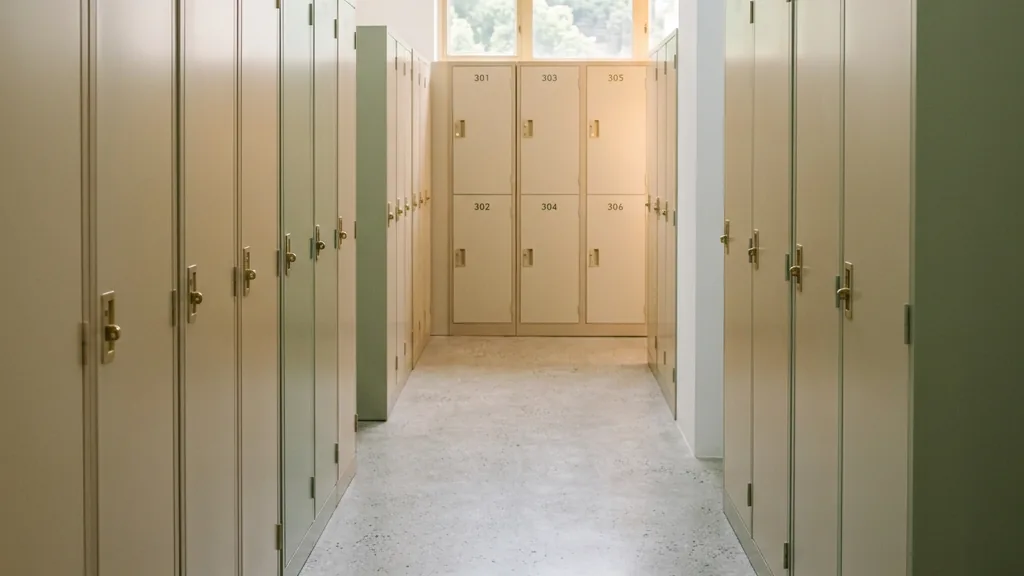
Mini-storage often uses planar area, overlooking ceiling heights, fire safety equipment, ventilation, and structural pillars. Large items may not fit despite sufficient square footage. Consult professionals for on-site spatial assessment before signing.
Living space in Hong Kong is limited, leading many to use mini-storage. While advertisements highlight square footage, tenants often find that large suitcases cannot fit even if the space seems adequate. This discrepancy typically arises from ignoring height, structural pillars, and door frame limitations. It is advisable to clarify the difference between advertised area and actual usable 3D space before signing any agreement.
The footage looks big enough but large items get stuck? Analyzing the physical blind spots of mini-storage corridors and three-dimensional space
Why do units advertised with specific square footage fail to accommodate a few large suitcases? This is often due to fire safety regulations requiring sprinkler systems or ventilation ducts, which restrict vertical stacking. Furthermore, structural pillars can segment the 3D space, and corridor width may limit the transport of large items. We recommend verifying these physical constraints before renting.
Will blindly stuffing the unit crush precious items? Comparing self-organized blind stacking with professional storage planning
Facing limited storage space, many people, in order to save money, choose to blindly stack all their suitcases and clutter, squeezing them together. This approach, which seems clever, actually hides huge risks of damage to items. To help everyone clearly understand the difference between self-stuffing and professional planning, we have compiled the core differences into the following practical comparison table:
Storage Planning Dimension | Blind Stacking and Stuffing | Professional Storage Space Planning |
Space Utilization Efficiency | Items of various sizes stacked messily, wasting many corner gaps | Scientific layering based on object size, perfectly activating every inch of 3D space |
Item Protection and Safety | Heavy items press on soft luggage or fragile items, easily causing deformation and damage | Reasonably distribute weight, hard boxes on the bottom, light items on top, protecting precious assets |
Access Convenience | Every time you get something, you have to move all the boxes, moving until your back aches | Smooth flow, categorized by type, easily access the required items at any time |
Too much clutter at home, should you tidy up yourself or just rent a small unit?
When your home is full of clutter and seasonal clothes have nowhere to go, many people face a choice: should they buy a few plastic boxes to organize themselves, or just rent the cheapest mini-storage online? At this time, it is crucial to clearly define the "safe DIY range" and the "range that requires professional technology." Your safe DIY range is mainly limited to initial decluttering at home, sorting clothes into boxes, or using standard small storage boxes for simple organization. However, do not blindly purchase units that do not fit your size or randomly stack heavy luggage without any concept of space planning. When it involves bulk luggage, large seasonal appliances, leather clothing that is susceptible to humidity and damage, or when you need precise 3D capacity calculations and selecting storage types with appropriate temperature and humidity control, you must rely on professional storage teams to provide objective advice.
Seek Help from a Professional Team
When you are worried about the large pile of suitcases and clutter at home, worried about renting the wrong mini-storage and wasting money, or feeling dizzy about various "square footage" calculations, rather than blindly guessing and taking risks, why not entrust this heavy task of space assessment and storage planning to our professional mini-storage team? We have years of rich experience in Hong Kong local storage space management, large luggage storage planning, and customer consultation, and we deeply understand the pain points of Hong Kong families and tenants in storage.
Through professional on-site dimension comparison, transparent capacity assessment, and attentive storage recommendations, we accurately calculate the actual space required for every suitcase and clutter, eliminating the trouble of "book says enough space, but reality is it won't fit." When you want to free up more comfortable space for your home and enjoy an efficient and convenient storage experience, our professional support can help you easily handle all your storage difficulties.
Common Questions
Q1: Why is there often a discrepancy between the square footage advertised by mini-storage and the actual number of suitcases that can be put in?
A: Because mini-storage labeling is mostly based on flat square footage, without considering building structure pillars, height restrictions of fire sprinklers, and storage door opening widths. Large suitcases are three-dimensional objects; if the space is cut by pillars or the height is insufficient, there will be a situation where it is enough on paper but cannot actually be stuffed in.
Q2: How can I maximize every inch of 3D space when renting mini-storage to store large suitcases and seasonal clothes?
A: It is recommended to choose hard storage boxes of consistent size in combination with suitcases. Put the heaviest or least-used luggage on the bottom layer and light clothing on the top layer; at the same time, ask the staff about the actual usable height and corridor width before renting to avoid blind stacking.
Q3: How can I accurately assess how big a storage unit I need to rent before signing a mini-storage contract?
A: It is recommended to first arrange all the large suitcases and boxes that need to be stored at home and measure the total volume, or directly provide an inventory list to consult with the professional mini-storage team, who will recommend the most suitable storage type based on actual 3D volume, avoiding waste from renting too large or not being able to fit items in due to too small space.
One Plus One Storage Services
One Plus One Storage provides professional mini-storage services, dedicated to offering citizens flexible, convenient, and reasonably priced storage solutions. We deeply understand the issues of land supply shortages during Hong Kong's urbanization process, and the current situation where changing work patterns have led to an increasing demand for residential space among citizens. Therefore, we established One Plus One Storage to respond to these growing demands.
Our mini-storage units come in various sizes; whether customers need small storage spaces for personal items, or large storage spaces to store company files or furniture, we can provide suitable solutions. Additionally, our pricing is fair and transparent, and we offer flexible rental periods, allowing customers to choose flexibly based on their own needs, whether for long or short-term rental.
Welcome to request a quote or inquire: Click to contact us via WhatsApp
- Address: Room 16-17, 9/F, Nan Fung Commercial Centre, 19 Lam Lok Street, Kowloon Bay
- Phone: 3188 1889
- WhatsApp: 6928 9628
- Email:enquiry@opostorage.com
Feel free to contact us anytime, and let us provide you with professional mini-storage
Practical storage and planning
- Record the dimensions of items to calculate total volume rather than relying on square footage.
- Check actual height clearances and verify if structural pillars impede the unit space.
- Consult professional teams for spatial planning to avoid renting unsuitable storage units.
Frequently asked questions
Why might a unit appear large enough on paper but fail to hold large items?
Structural components like fire sprinklers, ventilation ducts, or building pillars often occupy usable height or floor space, preventing planar area from being fully utilized as 3D storage space.
How can I accurately assess the required unit size before renting?
Measure the total volume of all large items stacked at home and provide a detailed inventory to the storage team so they can recommend the appropriate unit type based on 3D volume.