
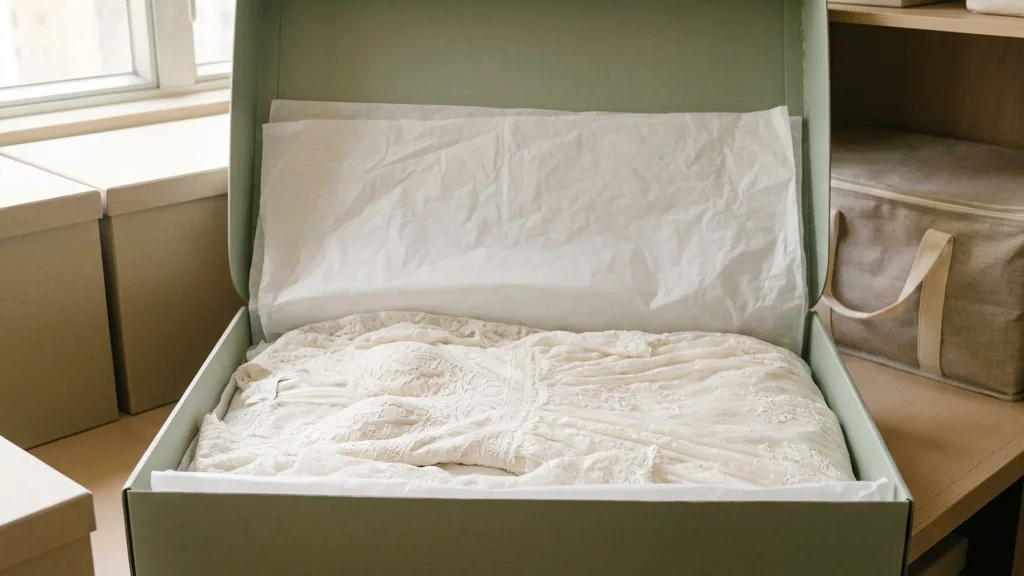
Do not store wedding dresses in dry-cleaner plastic bags as they may release chemicals that cause yellowing. Instead, remove the plastic, wrap the dress in acid-free paper, and store it in a breathable garment bag. For damaged or heirloom items, consult professional conservators instead of attempting DIY repairs.
When getting married or attending a grand banquet, putting on a bespoke pure white wedding dress and gorgeous evening gown, every stitch carries the most precious memories of a lifetime. After the ceremony, many Hong Kong brides happily send their dresses for dry cleaning, and upon retrieval, they hang them neatly in the depths of their wardrobes, sealed inside the clear plastic garment bags provided by the dry cleaner.
Who would have thought that three, five, or seven years later, when intending to relive memories or pass them on to the next generation, at the moment of unzipping, what meets the eyes is no longer snow-white lace and satin, but the entire dress from neckline to hem covered in indelible yellowish-brown spots, or even the white tulle overall yellowing and aging! Having been stored in a dark place with no sun exposure, why did sealing it in a clear plastic bag actually cause the wedding dress to yellow severely?
What serious pitfalls regarding fiber preservation and chemical volatilization are hidden behind this?
Heartbroken by Yellow Spots After a Few Years? Deconstructing the Chemical Tragedy Caused by Sealing in Plastic Dry-Cleaning Bags
Many people assume that dry-cleaner plastic covers are suitable for long-term storage. However, these materials are often not designed for protecting high-end fabrics over time. If a wardrobe has limited ventilation, keeping a dress sealed in plastic can create a trapped environment where residual moisture or chemical odors cannot dissipate, potentially impacting the fiber quality. It is advised to remove these bags promptly.
Why Does It Yellow Even Without Sun Exposure?
Many owners are concerned when their dresses turn yellow. When fabrics are stored in sealed, non-breathable environments for long periods, they may interact with surrounding gases or packaging materials, leading to color changes over time. Even in the dark, unsuitable storage conditions can lead to yellowing. It is recommended to ensure storage environments are breathable and free from trapped air.
Wrap with Acid-Free Paper or Change to Pure Cotton Bags?
For maintenance, follow these safety procedures: First, remove dry-cleaner plastic covers immediately after bringing garments home and hang them in a ventilated area to allow gases to dissipate. Second, use acid-free tissue paper to gently pad the dress and separate any metal buttons or sequins from the fabric to prevent contact issues. Use breathable cotton garment bags or acid-free storage boxes. Do not add household moth repellents to the box. If the dress has existing damage, consult a professional textile conservator rather than attempting to soak or repair it yourself.
Comparison of Various Storage Packaging Materials for Wedding Dresses and Evening Gowns: Which Storage Process Best Locks in the Snow-White Luster?
There are essential differences in the defensive power of different packaging materials against light, gas circulation, and chemical migration. To provide collectors with more evidence when managing expensive gowns, the following is a detailed comparison list of common wedding dress storage materials and environments, helping you accurately assess which strategy best suits long-term preservation needs:
Gown Packaging Materials and Storage Methods 👗 | Gas Permeability and Chemical Stability 💡 | Common Limitations and Potential Risks ⚠️ | Professional Advice from Mini-Storage Team ✅ |
Dry-Cleaner Clear Plastic Bag (PE/PVC) | Completely sealed, appears dustproof and waterproof initially | Volatilizes BHT causing phenolic yellowing, humidity leads to mold | Must be removed and discarded immediately after bringing home, avoid long-term storage |
Cheap Non-Woven Garment Cover in the Market | Has basic breathability, affordable and lightweight | Mostly made of polypropylene, easy to powder and crack after a few years, sticking to fabric | Suitable for short-term dust protection of ordinary clothes, not suitable for high-end gowns for long periods |
Acid-Free Paper with All-Cotton Garment Bag | Zero chemical migration, excellent breathability, gentle moisture absorption | Requires light-proof and moisture-proof environment, occupies fixed wardrobe space | Strongly recommended for high-end silk wedding dress and handmade evening gown storage |
24-Hour Temperature and Humidity Controlled Professional Storage | Maintains low temperature and dryness 24 hours a day, eliminates humidity yellowing | Requires paying corresponding exclusive storage space rental expenses | Suitable for heavy gowns with large hems and inheritance value |
Through the table above, it is clear that plastic bags are the culprit of phenolic yellowing. Changing to acid-free paper and pure cotton breathable bags, combined with a low-humidity and light-free environment, is the long-term strategy to safeguard snow-white luster.
Seeking Help from a Professional Team
In Hong Kong's "every inch of land is worth gold" home environment, the interior of an ordinary wardrobe cannot provide enough height for a gown to stretch naturally, and long-term pressure easily causes deformation. Coupled with Hong Kong's extremely humid climate for six months in spring and summer, if the home lacks 24-hour stable constant temperature and dehumidification, air humidity as high as 80-90% can easily induce mold to penetrate the cotton cover, ruining expensive hard work.
Instead of worrying daily, feeling anxious about your beloved souvenirs molding and yellowing, why not hand over the long-term preservation task of valuable wedding dresses and gowns to our professional mini-storage team? We help you properly place every beloved gown that carries life memories, fully releasing home living space, so that when you open the box to inspect at any time, the wedding dress is still as white as new and as radiant as before.
Common Questions
Q1: My wedding dress has yellowed, can I save it by soaking it in color-safe bleach or white vinegar?
A1: Soaking it yourself is highly discouraged. High-end wedding dresses usually mix delicate fabrics like silk and organza. Household color-safe bleach contains oxidizing chemicals, while white vinegar is acidic. Blind soaking can easily lead to embroidery shrinkage, sequin detachment, or even fabric hardening and cracking. If yellow spots have appeared, you should hand it over to a professional dry-cleaning team with antique garment restoration technology for local neutral reduction treatment.
Q2: Should a wedding dress be hung in the wardrobe or folded into an acid-free box?
A2: It depends on the weight of the wedding dress. If the wedding dress is covered with a large amount of heavy crystals, sequins, or is heavy-weight satin, long-term vertical hanging will cause shoulder straps and chest lines to stretch due to its own gravity, leading to permanent deformation of the fabric. It is recommended to wrap and fold these heavy gowns flat in acid-free boxes. If it is a light tulle style, you can use a thick sponge wide-shoulder hanger combined with a pure cotton cover for vertical hanging.
Q3: Why do the metal zippers and sequins on high-end evening gowns turn black all around after being stored for a long time?
A3: This is caused by metal oxidation and sulfurization reactions. Metal accessories in contact with humidity and trace sulfides in the air will slowly oxidize and turn black, or even transfer oxides to adjacent light-colored fabrics. When storing, be sure to use acid-free paper strips to completely separate metal zippers, hidden buttons, and surrounding fabrics to block the spread of chemical reactions.
One Plus One Storage Services
One Plus One Storage provides professional mini-storage services, dedicated to providing citizens with flexible, convenient, and reasonably priced storage solutions. We have a deep understanding of the land supply shortage in Hong Kong's urbanization process, as well as the status quo where changing work patterns have led to an increasing demand for home space by citizens. Therefore, we founded One Plus One Storage to respond to these growing needs.
Our mini-storage units come in various sizes. Whether a customer needs a small storage space for personal items, or a large storage space to store company documents or furniture, we can provide suitable solutions. In addition, our pricing is fair and transparent, and we offer flexible rental periods. Whether for long-term or short-term rental, customers can flexibly choose according to their own needs.
Welcome to request a quote or inquiry: Click to contact us via WhatsApp
- Address: Unit 16-17, 9/F, Nan Fung Commercial Centre, 19 Lam Lok Street, Kowloon Bay
- Tel: 3188 1889
- WhatsApp: 6928 9628
- Email:enquiry@opostorage.com
Please feel free to contact us, let us provide you with professional mini-storage
Practical storage and planning
- Remove dry-cleaner plastic bags immediately after retrieval and hang in a well-ventilated area.
- Use acid-free tissue paper to pad folds and separate metal embellishments from the fabric.
- Store in a breathable cotton garment bag or an acid-free box in a climate-stable, dark location.
Frequently asked questions
Can I remove yellow spots on my wedding dress by myself?
DIY cleaning with household chemicals is not recommended as it may damage delicate fibers. Please consult a professional textile conservator for inspection and safe treatment options.
Should I hang or fold my wedding dress for storage?
It depends on the weight and embellishments. Heavy gowns with crystals or thick satin should be folded flat in acid-free boxes to prevent shoulder strap deformation, while lighter tulle dresses can be hung using wide padded hangers.
Further reading: Canadian Conservation Institute guidance by material