
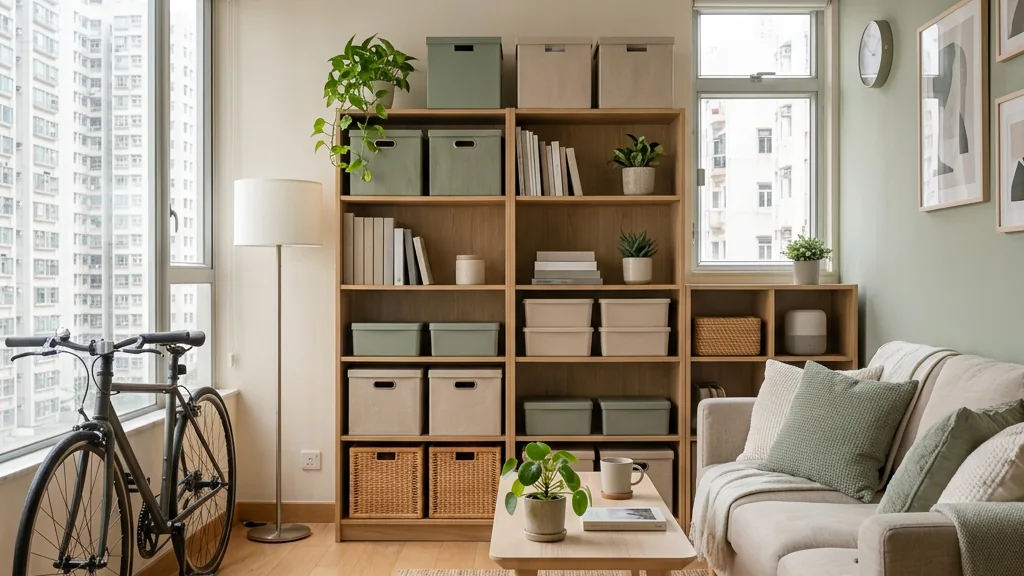
Assess the usage frequency and emotional value of your items to screen them. For seasonal or precious items, utilize external storage to maintain home order.
In Hong Kong, space has always been the most luxurious resource. Whenever I stand in the living room looking at the mountain-like piles of seasonal clothes, childhood memoirs, or even fitness equipment bought years ago but never unpacked, an inexplicable anxiety always arises in my heart. There is less and less space at home, and more and more clutter accumulates. I am reluctant to throw them away, but I have no idea where to start cleaning. This "hoarding mindset" not only occupies our precious living space but also invisibly increases daily mental pressure. Faced with a house full of clutter, how can we make living supplies flow again and find them a truly suitable home?
Is your home so small that it is hard to even turn around?
In Hong Kong's compact pace of life, many people unknowingly fall into the whirlpool of "hoarding." The house has a practical area of only three or four hundred square feet, yet it is stuffed with all kinds of items that one is reluctant to throw away. Behind this psychological state, it often includes a lack of security about the future, attachment to past memories, or the assumption that "it will be used someday." However, excessive hoarding not only makes the home environment messy and depressing but also seriously affects the fluidity of daily life. When the living room is occupied by clutter and even having a place to relax and rest is a problem, we need to stop and reflect: are these items really enriching our lives, or are they consuming our quality of life?
Blindly filling storage units or decluttering?
When space starts to become insufficient, many people's first reaction is to engage in extreme "decluttering," heartlessly throwing away a large number of items with commemorative value or items that might be used in the future; or blindly stuffing all the clutter into a storage unit and ignoring it from then on. In fact, these two extreme approaches often bring invisible costs. Blind decluttering is prone to strong feelings of regret afterward; and blindly renting an overly large space to store infrequently used items creates unnecessary economic burdens. The essence of item excess is not the fault of the items themselves, but our lack of a set of scientific material management and flow logic. Understanding the true value and frequency of use of items, and learning to distinguish between "needs" and "wants," are the key to breaking the deadlock.
Reluctant to throw away but can't put it down?
To allow living supplies to return to flow, the first step is to learn to categorize rationally. Faced with piles of items, you can find the right destination for them through clear screening steps:
💡 Step 1: Evaluate frequency of use and emotional value
Operation: Categorize items into four types: recently used, seasonal transition, commemorative value, and infrequently used.
Verification Method: Honestly face your own usage habits and avoid deceiving yourself with "might be useful."
💡 Step 2: Implement flow and precise positioning
Operation: Keep daily consumables with you; pack seasonal clothes and large spare items; and consider properly transferring and storing valuable assets that are not temporarily used.
Verification Method: Ensure that every item left behind has a clear functional or emotional orientation, not letting the space be filled with meaningless clutter.
To help everyone more intuitively understand the disposal plans for different items, we have organized the characteristics into the following comparison table:
Item Type and Characteristics 📦 | Discard or Donate (Decluttering) ♻️ | Temporary External Storage (Storage Transition) 🛡️ |
Daily consumables and expired items | Lost usage value or already damaged, recommended to directly classify for recycling or discard | Storing in external space will increase unnecessary costs and space waste |
Seasonal equipment and bedding | Voluminous and takes up a lot of wardrobe space, it's a pity to throw it away but it's not used daily | Use appropriate packaging for protection before transferring to storage. For valuable or fragile items, consult a professional preservationist first. |
Precious memories and collectibles | Extremely high emotional value but cannot be displayed normally, it's a pity to abandon | Place in appropriate storage containers within a professional environment. For precious items, seek professional advice on proper handling before storage. |
Through the comparison in the table above, it can be seen that not everything has to face the fate of being "thrown away." Through reasonable categorization and flow, different items can each find their place.
How should items be placed best?
When we decide to find an external home for some items, choosing an appropriate storage method becomes particularly important. Many people often face the dilemma of lack of space when dealing with seasonal down jackets, large suitcases, camping equipment, or temporary storage during renovations. At this time, making good use of professional external storage space becomes a high-efficiency space extension solution. However, storing items is not just simply stuffing them into a warehouse. We need to pay attention to moisture prevention, classification labeling, and regular inspection. The wisdom of reasonable storage lies in letting the space achieve dynamic balance: the home is responsible for current life, while the external space properly takes care of those assets that need precipitation or seasonal rotation, allowing life order to return to the right track.
Within the scope of daily DIY, if it is just organizing a few boxes of seasonal clothes or light items, users can completely do it themselves at home. But when it involves temporary storage of large furniture, massive books, or long-term transfer of valuable collectibles, space planning and professional storage support become indispensable.
Seeking help from a professional team
When you feel at a loss when faced with piles of private items, or your home space has reached a saturation state, and you spend a lot of time organizing yourself but still can't figure it out, instead of worrying alone and falling into the dead end of hoarding and cleaning, why not hand over space planning and material storage work to our professional storage team. We have rich local Hong Kong storage management experience, provide safe, dry, and flexible storage space solutions, and can provide the most proper external home for your living supplies. When you hope to let your home space breathe again and find back the freshness and order of life, our professional team is always ready to provide you with thoughtful support and help you easily solve space flow problems.
Common Questions (FAQ)
Q1: What types of items is storage suitable for storing?
A: Storage units are very suitable for storing seasonal clothes, thick quilts, large suitcases, camping or sports equipment, books, temporary furniture during renovations, and non-daily items with commemorative value. However, it is not recommended to store flammable, explosive, fresh food, or prohibited items.
Q2: How to judge whether your items should be decluttered or rented for storage?
A: If items have not been used at all for more than a year and have no emotional value, it is recommended to declutter or donate; conversely, if they are seasonally needed, voluminous but practical items that one is reluctant to throw away, or precious memories, then they are very suitable for storage.
Q3: Hong Kong's climate is humid, what should be paid attention to when placing items in external storage space?
When choosing storage, consider environmental factors. For valuable or specialized items, consult a professional preservationist regarding appropriate procedures prior to storage.
One Plus One Storage Services
One Plus One Storage provides professional storage services, committed to providing citizens with flexible, convenient, and reasonably priced storage solutions. We deeply understand the problem of land supply shortages in Hong Kong's urbanization process, as well as the status quo that the change in working patterns leads to an increasing demand for home space by citizens. Therefore, we established One Plus One Storage to respond to these growing needs.
Our storage units cover a variety of sizes. Whether customers need small storage space to store personal items, or large storage space to store company documents or furniture, we can provide suitable solutions. In addition, our pricing is fair and transparent, and we provide flexible lease terms. Whether it is long-term or short-term leasing, it allows customers to flexibly choose according to their own needs.
Welcome for quotation or inquiry: Click to contact us on WhatsApp
- Address: Room 16-17, 9/F, Nan Fung Commercial Centre, 19 Lam Lok Street, Kowloon Bay
- Tel: 3188 1889
- WhatsApp: 6928 9628
- Email:enquiry@opostorage.com
Feel free to contact us at any time, let us provide you with professional storage
Practical storage and planning
- Categorize your belongings based on usage frequency and emotional value.
- Keep daily items accessible and pack others for appropriate storage.
- Consult professional preservationists for valuable or sensitive items requiring long-term storage.
Frequently asked questions
How to decide whether to declutter or rent storage?
Evaluate if an item has been used within the past year. If it has no practical use or emotional value, consider decluttering; otherwise, store it properly.
What to note when storing valuable collectibles?
For items of high value or delicate materials, consult professional preservation specialists for appropriate storage advice rather than attempting DIY methods.
Further reading: Canadian Conservation Institute guidance by material