
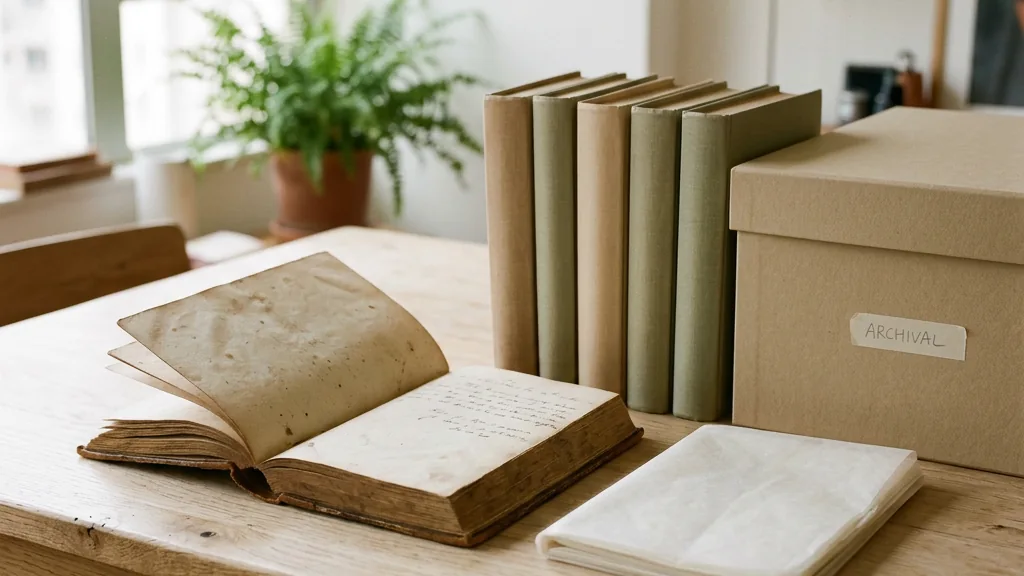
Yellow spots alone cannot identify the cause of paper staining or show whether cleaning is safe. Check for dampness, musty odours and stuck pages, and separate suspect books from the collection. Do not bleach, heat or rub the spots. Valuable or damaged books need assessment by an appropriate paper conservator.
For book collectors, second-hand manga fans, or vinyl record enthusiasts in Hong Kong who love literature, history, and philosophy, there are always some out-of-print first editions, antique rare books, or first-edition art albums hidden at home. Whenever you take out beloved books from the depths of moisture-proof cabinets or bookshelves, carefully opening the yellowed pages, dense dark brown "tea spots" (known as Foxing) like sesame seeds or freckles appear before your eyes.
These spots, deposited at the bottom layer of the paper fibers, cannot be wiped away and gradually spread to inner pages over the years, making the original clean paper quality become brittle and fragile. The auction value of the books is immediately halved, which is heartbreaking! Even though they haven't been dripped with water or soaked for many years, are these spots, which look like rust, caused by trace metal oxidation remaining from paper manufacturing, or is it fungus spores at work?
In Hong Kong's high-humidity climate, how can precious paper documents be correctly extended in life?
Delighted to Open Out-of-Print Collection to Find Yellow Spots? Deconstructing the Heartache and Anxiety of Antique Book Collectors
Many Hong Kong collectors often mistakenly believe that paper yellowing is a natural trace of time when examining old books, but they fall into great anxiety when seeing yellow-brown circular spots scattered like raindrops. These tea spots usually spread to the center from the page cuts, the top and bottom of the book, and the edges of the flyleaves. Visually, the spots are dark brown, yellow-brown, or rusty red, mostly in the shape of irregular concentric circles or frayed clouds.
For the collector market, once books appear with irreversible tea spots, the condition rating often drops directly from excellent to the reader level, and the value shrinks significantly. What is more alarming is that tea spots often deepen in humid environments, and the paper structure at the spots becomes extremely fragile due to cellulose hydrolysis, even shattering into powdery gaps with light folding. Many book lovers worry that these spots are like a contagious disease, affecting other precious classics on the bookshelf, and worry all day without knowing how to deal with them.
The cause of paper spots cannot be established by appearance alone. Yellow spots do not confirm active mould or show that removal is safe. Record the condition and check for musty odours or dampness before deciding whether a conservation assessment is needed.
In document preservation, spots on antique paper are often considered the result of environmental interactions. Fluctuations in humidity may affect the internal condition of the paper or provide conditions for biological activity. Maintaining a stable environment is recommended to minimize these risks.
Lightly Wiping with an Eraser or Using Acid-Free Absorbent Tissue Paper?
Check the environment and the condition of the book first. Do not brush suspected mould, force stuck pages apart, or bleach, heat or rub stains. Valuable or damaged books need assessment by an appropriate paper conservator.
Competition of Paper Preservation Containers and Environments: Which Storage Process Can Best Lock in Page Whiteness?
Different containers and storage spaces have significant differences in temperature and humidity stability, chemical gas release, and insect and mold prevention effectiveness. In order to help every Hong Kong collector have a better basis for collecting out-of-print ancient books and manga, the following is a detailed comparison list of common book collection environments to help you accurately assess which strategy best meets long-term preservation needs:
Book Collection Environment and Storage Container Mode 📖 | Temperature and Humidity Control Mechanism and Working Characteristics 💡 | Potential Paper Damage Risks ⚠️ | Professional Advice Strategy from Storage Team ✅ |
Open Traditional Wooden Bookcase | Extremely convenient for reading access, visually elegant and beautiful | Directly exposed to moisture in the "Returning South" season, wood panels volatilize formic acid to aggravate acidification | Requires cooperation with all-weather home dehumidification, avoid placing near exterior walls |
Sealed Transparent Plastic Storage Box | Dust-proof and waterproof, price-friendly, easy to stack | Plastic sealing blocks ventilation, internal accumulation of acidic gases leads to stuffy yellow spots | Only suitable as a short-term dust-proof transition, avoid long-term storage |
Household Electronic Humidity Control Cabinet | Precisely locks humidity within a safe range (45-55%) | Cabinet capacity is limited and costs are expensive, unable to accommodate a large number of books | Suitable for placing a small number of unique editions, precious ancient books, or first-edition signed copies |
All-Weather Constant Temperature and Humidity Professional Storage | 24-hour maintenance of low temperature and dryness, eliminating mold and oxidation | Requires payment of corresponding exclusive storage space rental expenses | Strongly recommended for the preservation of large numbers of precious books, art albums, and paper files |
Through the above table, it can be clearly seen that plastic box sealing easily accelerates internal acidification and fermentation, while ordinary bookshelves are difficult to resist the moisture of Hong Kong's "Returning South" season; placing precious books in an environment that is long-term constant temperature and humidity and shielded from light is the long-term prescription to insulate against metal oxidation and fungal tea spots.
Seeking help from professional teams
In Hong Kong's home environment where every inch of land is precious, the plum rain and "Returning South" season that last for half a year in spring and summer often cause indoor air humidity to soar to over 80% to 90% at any time; combined with kitchen cooking fumes, dust in corridors, and continuous sunlight ultraviolet irradiation outside the window, this can easily induce rapid oxidation of trace metals inside the paper and massive reproduction of xerophilic fungi.
Hundreds and thousands of thick art albums, out-of-print manga, and historical rare books, if stacked for a long time in cramped wardrobes or under beds, are easily moldy and sticky in non-ventilated and heavy-squeeze environments, and even attract silverfish to eat them. Instead of being worried and anxious every day about the yellowing and spotting of beloved books, it is better to hand over the long-term preservation task of precious paper documents to our professional storage team.
We will help you properly place every beloved book that carries the memory of time, completely release home living space, and make sure that when you look it up at any time, the book pages are still flat, dry, and look brand new.
Common Questions
Q1: There are tea spots on the pages. Can I dry them in the sun or blow them away with a hair dryer?
A1: Highly not recommended. Ultraviolet rays in strong sunlight will accelerate the photochemical reaction of lignin, causing paper to yellow and become brittle rapidly within a few hours; the high temperature of a hair dryer will drain the natural moisture of the fibers, causing paper to warp in a wave shape or the glue on the book spine to melt and degum; paper that is damp should be air-dried naturally in a cool, ventilated place combined with low-temperature dehumidification.
Q2: Why does an out-of-print book put in an ordinary sealed plastic bag yellow and spot faster after a few years?
A2: Because the air permeability of ordinary plastic bags is close to zero. Old paper itself will slowly release acidic by-products as it ages. Sealing it in a plastic bag will form a "miniature greenhouse acidification effect." The trapped acidic gases and trace moisture cannot dissipate, which in turn significantly accelerates the hydrolysis of paper fibers, forming denser tea spots.
Q3: Will tea spots spread like a contagious disease to other books that haven't developed spots?
A3: If it is fungal tea spots, in a high-humidity state where the relative humidity of the environment exceeds 65%, free spores indeed have the opportunity to attach to and spread to adjacent books; but if it is purely catalytic oxidation of metal impurities, it is not contagious; the safest way is to separate with acid-free paper and strictly control the storage environment humidity.
One Plus One Storage Services
One Plus One Storage provides professional storage services, committed to offering citizens flexible, convenient, and reasonably priced storage solutions. We deeply understand the problem of land supply shortages in Hong Kong's urbanization process, as well as the current situation where changes in working patterns lead to an increasing need for home space among citizens. Therefore, we founded One Plus One Storage to respond to these growing needs.
Our storage facilities cover a variety of sizes; whether customers need small storage spaces for personal items or large storage spaces for company documents or furniture, we can provide suitable solutions. In addition, our price setting is fair and transparent, and we offer flexible lease terms, allowing customers to choose flexibly according to their own needs, whether for long-term or short-term leases.
For quotes or inquiries, please: Click to contact us via WhatsApp
- Address: Unit 16-17, 9/F, Nan Fung Commercial Centre, 19 Lam Lok Street, Kowloon Bay
- Tel: 3188 1889
- WhatsApp: 6928 9628
- Email:enquiry@opostorage.com
Feel free to contact us at any time, let us provide you with professional storage
Practical storage and planning
- Check for musty odours, dampness and stuck pages. Isolate suspected mould-affected books; do not brush the spots.
- Keep the binding and pages intact. Do not force stuck pages apart; choose a protective box that fits the book.
- Avoid sunlight, leaks and damp walls. Check books and packaging regularly rather than relying on a sealed bag.
Frequently asked questions
Can I remove yellow spots from books myself?
Do not bleach, heat or rub the spots: these treatments can cause irreversible damage. Isolate books with musty odours, stuck pages or fragile paper, and seek advice from an appropriate conservator.
Is a plastic bag always suitable for long-term book storage?
No. Books and packaging should be dry, and the package must not compress the spine. A sealed bag does not replace environmental management; select packaging appropriate to the paper, condition and intended use.
Further reading: US National Archives guidance on storing papers and photographs; Canadian Conservation Institute guidance by material