
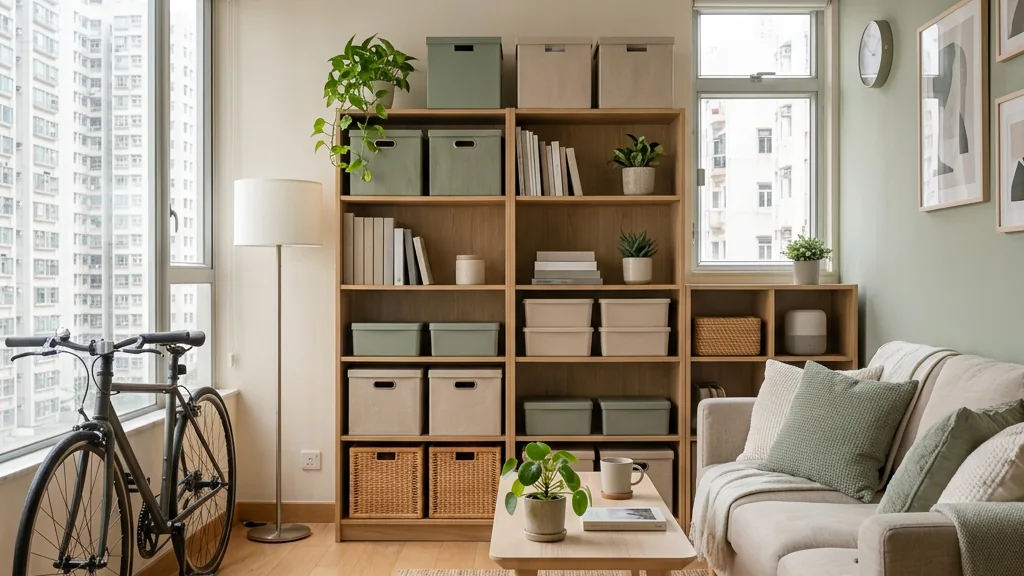
Relocating infrequently used items, seasonal goods, or collectibles from the living room to mini storage frees up space. This decluttering improves daily traffic, enhances cleanliness, and restores the living room's primary role for family activities.
Living space in Hong Kong is limited, and the living room often serves multiple functions: resting, dining, working, parent-child activities, and receiving guests. As seasonal items, cardboard boxes, toys, suitcases, collectibles, and spare household goods gradually accumulate, the living room can easily change from the core of life into a temporary storage area. The value of mini storage is not just having another place to put items; it can also help families move infrequently used items out of daily traffic routes, allowing the living room to return to a more comfortable state.
Living room sundries affect daily traffic routes
The living room is one of the most frequently used spaces in the home. If sundries are stacked on the ground and along the walls for a long time, daily movement, cleaning, and furniture usage may be affected. Suitcases, storage boxes, holiday decorations, and large toys, if they do not have a fixed position, can easily occupy walkways and corners. These items may not need to be used every day, but keeping them in the living room for a long time will make the space look crowded. Transferring some low-frequency items to mini storage helps to free up daily activity ranges.
Infrequently used items can be diverted first
When organizing the living room, you can divide items into categories: frequently used, occasionally used, and temporarily unused. Frequently used items can stay at home, such as remote controls, daily documents, chargers, and children's current toys. Occasionally used or seasonal items, such as travel suitcases, winter quilts, holiday decorations, camping gear, and spare appliances, can be considered for placement in mini storage. This diversion method does not necessarily need to be completed all at once, but it can gradually reduce the clutter in the living room.
Mini storage is suitable for storing seasonal items
Many common living room sundries in Hong Kong households are seasonal items. For example, Christmas decorations, Lunar New Year items, fans, heaters, thick winter quilts, seasonal clothing, and outdoor activity gear. These items may only be used a few times a year, but they are bulky, and keeping them at home for a long time will occupy a lot of space. Mini storage can serve as an external storage location for these types of items, so the living room does not have to bear the storage pressure of seasonal items for a long time.
Collectibles need suitable space
Many families place models, handbags, books, souvenirs, photo albums, or audio equipment in the living room. Some of these items have emotional value. If there is insufficient display space at home, items stacked over time may look unorganized or face risks. Mini storage can assist in storing items not currently on display, and it is recommended to consult professionals for the preservation of valuable items.
Children's items can be sorted by stages
In families with children, the living room is often occupied by toys, picture books, learning materials, and large game mats. As children grow, items at different stages are replaced quickly, and some are temporarily not used but you may not want to deal with them immediately. If all these items are left in the living room, the activity space will be reduced. Items that are not suitable for the age stage, temporarily unused, or that you hope to keep can be classified and put into boxes, and then placed in mini storage as needed, so the home can retain the items truly needed at the current stage.
Living room cleaning will be easier
The more sundries, the more difficult the cleaning. If the living room floor is piled with storage boxes and paper bags, vacuuming, mopping, and dusting will become less smooth. Items by the cabinet edge, in wall corners, and next to the sofa that are not moved for a long time are also prone to dust accumulation. After moving some items out of the home space, cleaning routes will be clearer, and daily maintenance will be more labor-saving. For families with busy work or children and pets at home, reducing exposed sundries helps maintain basic neatness.
Can be used as a buffer during renovation or moving house
The living room is usually the easiest position to be filled by items during renovation and moving house. Furniture needs to be cleared before renovation, and after moving house, there may be a large number of cardboard boxes temporarily stacked. Mini storage can serve as a transitional space to temporarily store furniture, household goods, and sundries that are not urgently needed, allowing more activity range for construction, cleaning, or new home organization. This type of arrangement is not necessarily only suitable for long-term storage, but can also be used as a short-term buffer according to actual needs.
External storage makes home functions clearer
The ideal state of a living room is to be able to cooperate with daily family life, not to be occupied by a large number of sundries. When all items are left at home, the space function is prone to becoming chaotic. After transferring low-frequency items, spare materials, and collectibles to mini storage, the living room can be re-dedicated for resting, communication, parent-child activities, or work. This diversion concept does not necessarily mean reducing all items, but letting different items return to more suitable positions.
Sort and protect before storing
Before using mini storage, it is recommended to sort items first, such as clothing, documents, books, collectibles, appliances, holiday items, and children's items. Fragile items can be wrapped with protective materials, clothing should be kept in a dry environment, and documents or albums can be placed in sealed boxes. Labeling the outside of each box makes it more convenient to retrieve items later. Clearer classification usually improves storage efficiency.
Seek professional team assistance
If the living room has been occupied by sundries for a long time, or if the home is facing moving house, renovation, seasonal sorting, accumulation of parenting supplies, etc., you can consider seeking professional team assistance. Professional mini storage teams generally assist in arranging suitable storage methods according to item type, storage time, space requirements, and access habits. Mini storage is not just about moving items away, but about reallocating home space, reducing the sense of crowding in the living room, and making daily life more orderly.
One Plus One Storage Services
One Plus One Storage provides professional mini storage services, committed to providing citizens with flexible, convenient, and reasonably priced storage solutions. We have an in-depth understanding of the land supply shortage during Hong Kong's urbanization process, as well as the current situation where changing work patterns have led to an increasing demand for home space by citizens. Therefore, we founded One Plus One Storage to respond to these growing needs.
Our mini storage covers a variety of sizes; whether customers need small storage spaces to store personal items, or large storage spaces to store company documents or furniture, we can provide suitable solutions. In addition, our pricing is fair and transparent, and we provide flexible rental periods; whether long-term or short-term rentals, customers can flexibly choose according to their own needs.
Welcome to request a quote or inquire: Click here to contact us via WhatsApp
- Address: Room 16-17, 9/F, Nan Fung Commercial Centre, 19 Lam Lok Street, Kowloon Bay
- Tel: 3188 1889
- WhatsApp: 6928 9628
- Email:enquiry@opostorage.com
Feel free to contact us at any time, let us provide you with professional mini storage services!
Practical storage and planning
- Sort living room items into categories based on frequency of use.
- Use appropriate protective packaging for stored items and label boxes for easy retrieval.
- Transfer sorted items to mini storage to reclaim daily living space.
Frequently asked questions
Why is keeping all items at home not recommended?
Persistent clutter can impede daily cleaning routes and increase the risk of damage or dust accumulation; distributed storage helps maintain a manageable home environment.
Further reading: US National Archives guidance on storing papers and photographs