
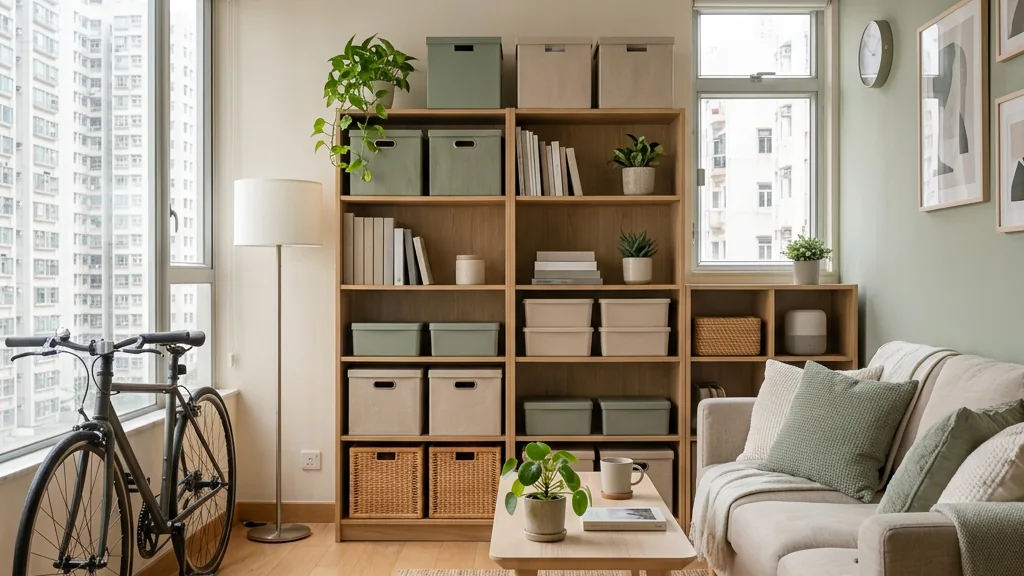
By relocating seasonal items and non-daily essentials to a self-storage unit, you can reduce home clutter, release visual space, and restore your residence to its core function of rest.
In Hong Kong, a city where land resources are precious, nano-apartments have become a housing choice for many young families and singles. Facing limited indoor space, how to create comfort and aesthetics in a cramped environment has become a lifestyle challenge pursued by modern urbanites. The minimalist aesthetics that have emerged in recent years emphasize the life philosophy of "less is more," allowing space to return to simplicity and purity by reducing unnecessary clutter. However, minimalism does not require discarding all items, but rather intelligently redistributing spatial resources.
How External Storage Realizes Spatial Visual Liberation
Moving non-daily items to a self-storage unit can immediately bring visual liberation to your home space. When the living room is no longer piled with clutter boxes, the bedroom wardrobe is no longer overstuffed, and bookshelves only display selected books, the transparency and "breathing room" of the entire space will significantly improve. Minimalist aesthetics focus on clean lines, harmonious colors, and white space—elements easier to achieve after reducing items. Through external storage, residents can keep only the items they truly need and appreciate at home, while the rest are properly stored in a warehouse. This approach not only preserves the integrity of the items but also allows the residence to return to its essential functions, becoming a place for true rest and living.
Practice Principles of Minimalist Aesthetics and Item Classification
To create minimalist aesthetics through external storage, items need to be classified systematically. It is recommended to divide items into three categories: daily essentials, seasonal items, and sentimental keepsakes. Daily essentials such as seasonal clothing, commonly used kitchenware, and work-related items should be kept at home in accessible locations. Seasonal items such as thick winter blankets, festive decorations, sports equipment, etc., can be stored in the warehouse during off-seasons. Sentimental keepsakes such as old photos, souvenirs, and collections, while not often looked at, have important significance and are also suitable for long-term storage in a warehouse. Through this type of classified management, you can ensure that only the items truly needed are left at home, realizing the maximum utilization of space.
Dynamic Balance Between External Storage and Home Space
Minimalist aesthetics is not an unchanging state, but a dynamic balance that can be adjusted according to life needs. When the season changes, residents can go to the warehouse to extract the items they need while exchanging the items that are no longer in use for storage. This regular rotation of items can not only keep the home space fresh and clean but also allow each item to play its role at the most suitable time. For those with broad interests or who need a variety of tools for their profession, external storage is an indispensable extension of space. For example, photography enthusiasts can store infrequently used lenses in the warehouse, and sports enthusiasts can rotate bicycles and ski equipment according to the season, allowing the nano-apartment to always remain simple and orderly.
Seeking Professional Team Assistance
To leverage external storage for spatial planning, select a service provider that offers a suitable environment for your items. Verify that the facility's security and management features meet your needs, and review rental agreements and logistics support to ensure the storage solution suits your daily routine.
One Plus One Storage Services
One Plus One Storage provides professional self-storage services, dedicated to offering citizens flexible, convenient, and reasonably priced storage solutions. We deeply understand the issue of land supply shortages in Hong Kong's urbanization process and the current situation where changing work patterns have led to an increasing demand for home space. Therefore, we founded One Plus One Storage to respond to these growing needs.
Our self-storage units cover a variety of sizes. Whether customers need small storage space to store personal items or large storage space to store company documents or furniture, we can provide suitable solutions. In addition, our pricing is fair and transparent, and we provide flexible rental periods. Whether it is a long-term or short-term lease, customers can flexibly choose according to their own needs.
For quotes or inquiries, please contact us: Click here to contact us via WhatsApp
- Address: Room 16-17, 9/F, Nan Fung Commercial Centre, 19 Lam Lok Street, Kowloon Bay
- Tel: 3188 1889
- WhatsApp: 6928 9628
- Email:enquiry@opostorage.com
Feel free to contact us at any time, and let us provide you with professional self-storage services!
Practical storage and planning
- Sort your items into daily essentials, seasonal items, and sentimental keepsakes.
- Relocate items that are not used daily or are seasonal to a professional storage unit.
- Maintain home spaciousness by periodically reviewing and rotating your stored items as needed.
Frequently asked questions
How should I handle precious items like old photos or heirlooms?
For precious or historical items, consult with a qualified conservation specialist regarding appropriate storage requirements rather than relying solely on standard self-storage.
Do storage facilities guarantee that my items will remain in perfect condition?
Commercial storage facilities provide space and basic convenience; they do not guarantee the condition of stored items. For delicate items, seek professional restoration or storage advice.
Further reading: US National Archives guidance on storing papers and photographs; Canadian Conservation Institute guidance by material