
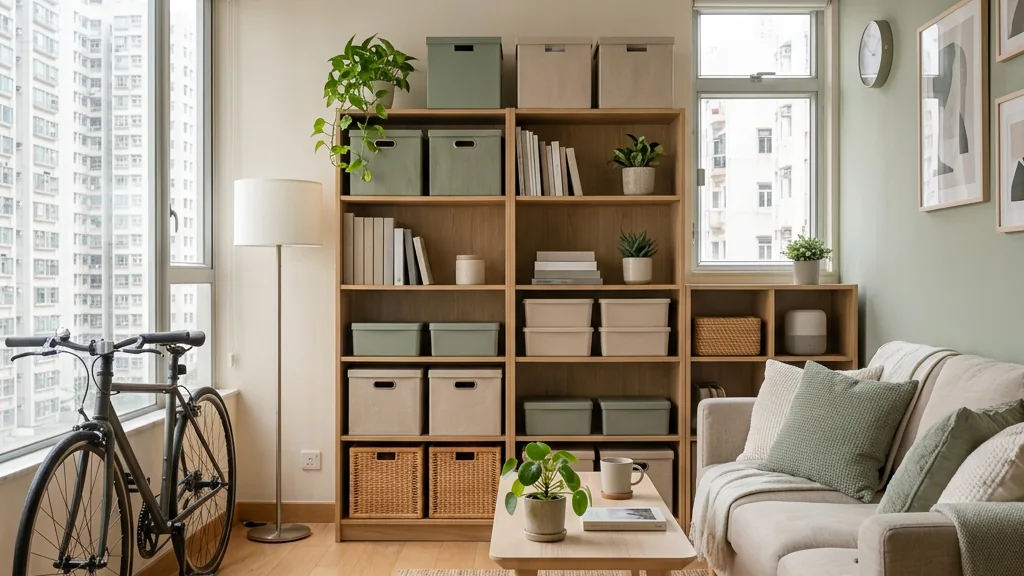
Clutter can reflect the quantity of belongings, cabinet depth, organisation and daily access habits. Identify items that repeatedly lack a place, then plan display, closed storage and labels without a fixed cabinet ratio. Compare sorting, donating and additional storage costs rather than simply buying more cabinets.
Whenever we see a home cluttered with miscellaneous items and feel annoyed, our first reaction is often: "Oops, I have too much stuff, it's time for a big decluttering!" So, we start crazily throwing things away and buying more storage boxes online. However, after struggling all day, we are frustrated to find that although the miscellaneous items seem to be put away, the whole room still looks oppressive and disorganized.
In fact, there is a hidden home design truth that most people ignore: The culprit that makes a room look messy is often not that there are too many things, but that you chose the wrong "cabinet."
Below is an in-depth dissection of the four core blind spots of "what's wrong with the cabinet," and how to truly restore the room's freshness and order through adjusting your cabinet philosophy.
Too many open cabinets: Exposing "visual noise" nakedly
Many people, for the sake of convenience or internet-famous styles, like to use large areas of open shelves, doorless bookcases, or iron racks at home. However, this is the number one culprit for a messy room:
Unconcealable visual noise: Every object's color, shape, and font/logo on packaging is a kind of "visual information." When dozens of items of different colors and shapes are exposed on open shelves without any covering, the brain receives overloaded visual stimuli and automatically defines it as "messy."
The gap between ideal and reality: The open cabinets in internet-famous photos look good because they only hold two or three carefully selected pieces of art. But in real life, we put cables, pills, snack bags, and various miscellaneous items, completely unable to maintain aesthetics.
Imbalance of cabinet height and depth: "Stuffing deep" leads to "messy placement"
In Hong Kong residences (especially small units) where every inch of land is valuable, many people only pursue "large capacity" when buying cabinets, ignoring ergonomics and spatial proportions:
Deep storage cabinets that lack proper partitioning can lead to items being stacked, which may make it difficult to retrieve things and potentially cause disarray when moving items in front.
Proportional oppression: In Hong Kong units with low ceilings, blindly customizing a set of floor-to-ceiling, thick, heavy, dark-colored large wardrobes will instantly compress the breathing space of the room, making the entire living room or bedroom appear cramped and oppressive.
"Has a door but no cover": The invisible traps of semi-transparent and glass cabinets
Some people realize that open cabinets get messy easily, so they switch to glass doors or frosted glass cabinets, thinking this can be dustproof and keep it transparent, but the result is often counterproductive:
Semi-concealed mess is even more fatal: Fully transparent or semi-transparent glass cabinets will refract a blurry image of the colorful items inside. This state of "translucent but unclear" creates an inexplicable sense of complexity visually, looking messier than a neat open cabinet.
Lack of visual unity: If standard storage boxes are not used inside the cabinet to "hide the clutter," the shadows of miscellaneous items showing through will become a visual disaster for the space.
Cabinet style and wall color mismatch: Fragmenting the space
If the cabinet's own color, material, and design do not match the room's tone, it will also cause a sense of spatial fragmentation:
The consequences of "piece-meal" cabinet buying: You need a shoe cabinet today and buy a wooden one; tomorrow you need a chest of drawers and buy a dark brown one; the day after you add a plastic drawer unit. There are four or five different wood grains and materials in your home, and the visual focus is severely divided.
Lack of overall sense: Cabinet heights are uneven. Besides accumulating dust on top, it also cuts the space into pieces horizontally and vertically, naturally giving people an illusion of disorder.
How to correct "cabinet mistakes"? 3 Golden Rules for creating a fresh space
Since the culprit is the cabinet, how should we adjust? The following three principles can help you solve the problem fundamentally:
Adjust open shelving to display and everyday access needs rather than a fixed percentage. Sort belongings first, then use boxes or closed cabinets and check how conveniently items can be retrieved.
Make good use of standardized storage boxes: If you have already bought open cabinets or shelves, don't just stuff items in directly. Buy storage boxes or rattan baskets with uniform sizes and simple colors (like pure white, light gray, or original wood color), categorize your miscellaneous items, put them in, and label them to unify the visual surface.
Follow the "wall and cabinet same color" principle: Try to keep the color of large cabinets consistent with the wall color (e.g., white walls with white cabinets), using the method of "weakening presence" to make the cabinet seem to blend into the wall, instantly enlarging the sense of space.
Seek help from a professional team
When home storage is full and you prefer not to add more furniture, professional self-storage can serve as a solution for keeping seasonal clothing, large luggage, or keepsakes, provided you research the provider's terms beforehand.
One Plus One Storage Service
One Plus One Storage provides professional mini-storage services, dedicated to providing citizens with flexible, convenient, and reasonably priced storage solutions. We deeply understand the shortage of land supply in Hong Kong's urbanization process, and the reality that changing work patterns are increasing the demand for home space. Therefore, we founded One Plus One Storage to respond to these growing needs.
Our mini-storage covers various sizes. Whether customers need small storage space to store personal items, or large storage space to store company documents or furniture, we can provide suitable solutions. In addition, our pricing is fair and transparent, and we provide flexible lease terms, allowing customers to choose flexibly based on their own needs, whether for long or short-term leases.
Welcome to request a quote or inquire: Click here to contact us via WhatsApp
- Address: Units 16-17, 9/F, Nan Fung Commercial Centre, 19 Lam Lok Street, Kowloon Bay
- Tel: 3188 1889
- WhatsApp: 6928 9628
- Email:enquiry@opostorage.com
Feel free to contact us at any time, let us provide you with professional mini-storage services
Practical storage and planning
- Balance open shelves and closed cabinets around display and everyday access needs, not a fixed percentage. Start by grouping the most cluttered area in matching boxes.
- Use storage boxes of uniform color and size to organize items, preventing individual objects from creating visual clutter.
- Match large cabinet colors with your wall colors to minimize their presence and create a sense of expanded space.
Frequently asked questions
If I have existing open shelves that cannot be replaced, how can I reduce the visual mess?
Use storage boxes or woven baskets of matching color and material on the shelves to hide individual items and apply labels for a clean, uniform look.
What should I consider when looking for a professional storage service for items that won't fit at home?
Evaluate the convenience of the location, the service provider's history, lease flexibility, and storage conditions to ensure your seasonal or sentimental items are kept securely.