
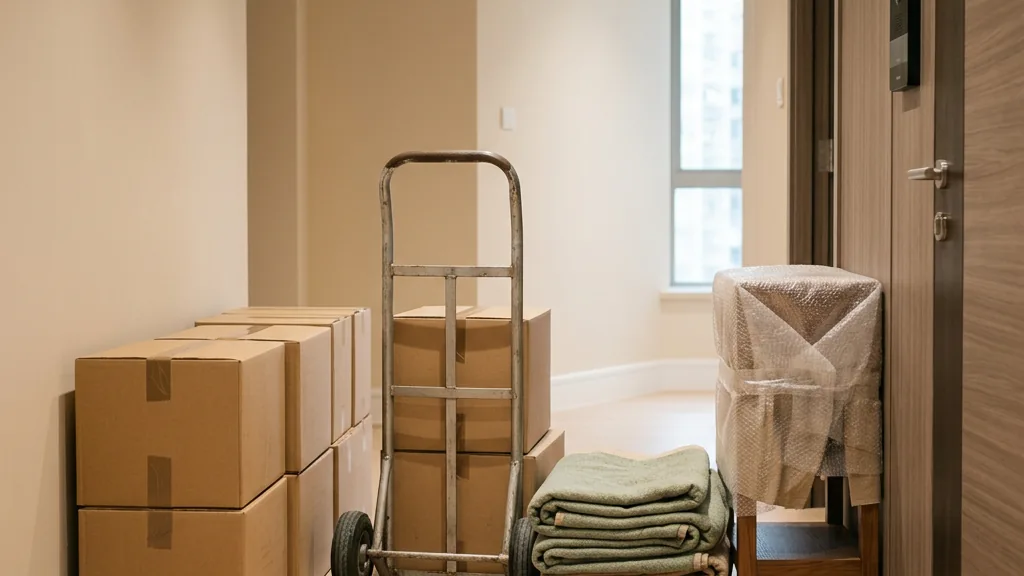
Sorting during a move focuses on aligning items with your new home's capacity based on usage frequency, using temporary storage to handle conflicted items.
Moving house is often the most profound opportunity to review one's life. Facing a house full of boxes of various sizes and life items accumulated over many years, the process of tidying up is not only a test of physical strength, but also a psychological tug-of-war regarding what to keep and what to let go. Looking at the items that have accompanied us, or those we purchased blindly at the time, we often fall into the conflict of being reluctant to part with them. In fact, sorting during a move does not mean forcing yourself to be a minimalist, but rather using a systematic way of thinking to clarify the relationship between your items and your current life, thereby allowing your new home to have a more refreshing and flexible start.
Using the new home's actual capacity and layout as an objective boundary
Before starting the sorting process, the most practical test often comes from the physical space of the new home. The dimensions of the closets, the lighting in the living room, and the corner structures of the rooms all determine the upper limit for where items can be placed. If you blindly pack large furniture or excessive storage boxes that were purchased to fit the layout of your old home, you may find upon moving in that they don't fit or even obstruct your daily living paths. Focusing your vision on future life scenarios and using the capacity of the new space as a starting point for screening can help you more rationally filter out heavy objects that no longer fit into your future.
Introducing the cross-quadrant rule to categorize by usage frequency and emotional value
When facing piles of clutter, relying solely on intuition often makes progress stall due to temporary emotional fluctuations. At this point, try establishing in your mind a cross-quadrant based on 'usage frequency' and 'emotional value.' For those essential items used daily with high practicality, they naturally belong on the packing list; however, for low-frequency items that haven't been used in years and have no special sentimental value, you can confidently place them in the 'to-be-discarded' pile, avoiding unnecessary weight added to your new home.
Setting a time limit for old items you 'might use later'
During sorting, you may find well-maintained items left unused for a long time. If an item has not been utilized for a significant period, consider whether it aligns with your future needs.
Promoting digital transformation of paper and media memories to simplify volume
Many space-consuming and heavy items in our lives often stem from accumulated books, photo albums, school-era notes, or various receipts and documents. For these items that carry heavy memories but are rarely looked at, actively using digital tools is a very gentle and practical strategy. Through high-resolution scanning or photography, these textual and visual memories can be saved as encrypted cloud files, allowing you to review and reminisce at any time while significantly reducing the number of physical boxes to move, letting your words and memories accompany you forward in a lighter form.
Setting up a 'temporary observation box' for items you are conflicted about to relieve anxiety
If, while sorting, you still feel a fierce tug-of-war between logic and emotion regarding a specific item, there is no need to force yourself to make an immediate black-and-white decision. When packing, prepare a special 'temporary storage box,' place these items you cannot bear to part with inside, and put a label with a date six months after your move-in on the box. Once you reach the new environment, place this box in a less conspicuous corner. When the promised time comes and you reopen it, you will find that as your life rhythm shifts, you can face many of the items you couldn't let go of earlier with a more open-minded attitude.
Seeking professional team assistance
When moving large volumes, external storage may offer flexibility. We provide spatial consultations; please contact our team to discuss, while noting that historical details may not represent current offers.
One Plus One Storage Services
One Plus One Storage provides professional mini storage services, dedicated to offering citizens flexible, convenient, and reasonably priced storage solutions. We have a deep understanding of the land supply shortages in Hong Kong's urbanization process, as well as the current situation where changes in work patterns have led to an increasing demand from citizens for home space. Therefore, we established One Plus One Storage to respond to these growing needs.
Our mini storage units cover various sizes; whether customers need small storage space for personal items or large storage space for company documents or furniture, we can provide suitable solutions. Furthermore, our pricing is fair and transparent, and we offer flexible rental periods, allowing customers to choose flexibly based on their own needs, whether for long or short-term rentals.
Welcome to request a quote or make an inquiry: Click here to contact us on WhatsApp
- Address: Room 16-17, 9/F, Nan Fung Commercial Centre, 19 Lam Lok Street, Kowloon Bay
- Phone: 3188 1889
- WhatsApp: 6928 9628
- Email:enquiry@opostorage.com
Feel free to contact us at any time, and let us provide you with professional mini storage services!
Practical storage and planning
- Evaluate the physical dimensions of your new home to establish limits
- Build a quadrant system based on frequency and sentimental value
- Digitize paper records and utilize temporary boxes for conflicted items
Frequently asked questions
How can I evaluate if long-stored items are worth keeping?
Observe how often you actually used the item. If it has been sitting unused for a long time without sentimental significance, consider releasing it.
Further reading: US National Archives guidance on storing papers and photographs; Canadian Conservation Institute guidance by material