
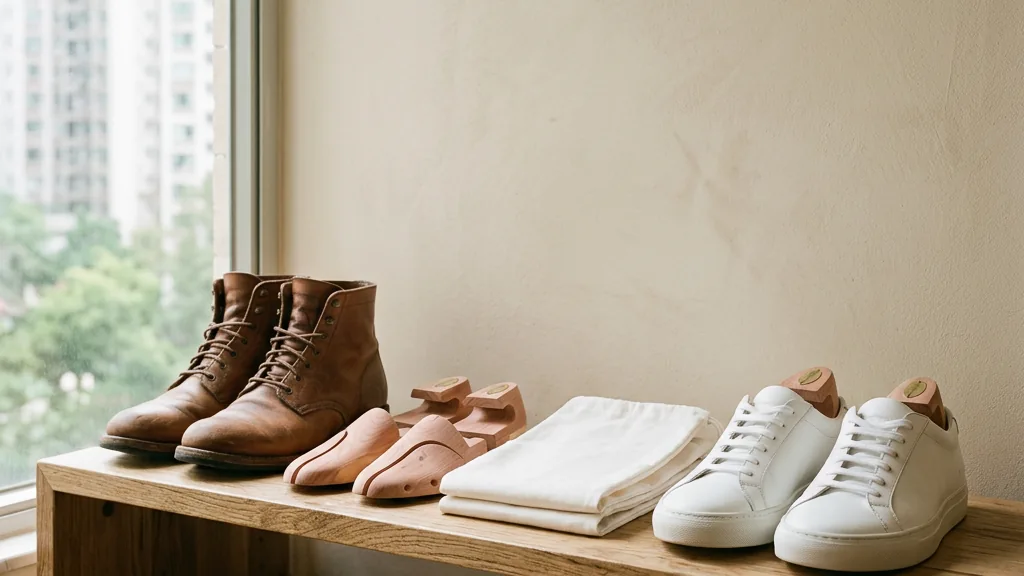
Deterioration occurs when moisture is trapped inside sealed boxes, creating condensation during temperature fluctuations that weakens shoe soles. Long-term storage without ventilation accelerates this process; maintaining airflow is essential.
Being a sneakerhead in Hong Kong is not easy. Whether it's a limited-edition Air Jordan painstakingly queued for and won in a draw, classic retro running shoes, or hype-priced collaboration god-tier shoes, every pair is a favorite. To protect their beloved shoes, many sneakerheads buy transparent sealed plastic boxes, wrap them in heat-shrink film, and even put in a few moisture-absorbing packets, stacking the sneakers neatly in the corner of their living room or room, thinking this will keep dust and moisture at bay.
Unexpectedly, after a few years, they happily open the plastic box to wear them out, and with a light step, the entire sole disintegrates like biscuit crumbs, or the whole sole detaches. Seeing a collection worth thousands or even tens of thousands of dollars turn into a pile of yellow fragments, that heartbreaking feeling is indescribable. Why do sneakers disintegrate via hydrolysis even when placed in sealed plastic boxes?
Opening the box to find beloved sneakers in biscuit crumbs? Why sealed plastic boxes become a breeding ground for hydrolysis
Many sneaker friends in Hong Kong are often confused: sealed plastic boxes clearly block outside air, so why do they accelerate sneaker aging? In fact, this phenomenon is closely related to Hong Kong's extremely humid climate and the airtight environment of plastic boxes. The relative humidity in Hong Kong often reaches over 80% during spring and summer.
When you put sneakers into a plastic box, the surrounding moisture and the trace sweat left on the shoes are sealed inside simultaneously. The plastic box itself is completely non-breathable, forming a "miniature greenhouse closed system." Many families turn off the air conditioning during the day while at work, causing indoor temperatures to soar; they turn on strong air conditioning when returning home at night, causing the temperature to plummet.
This drastic daily temperature fluctuation causes "condensed micro-moisture" inside the sealed plastic box. The previously dry environment inside the box saturates rapidly under temperature fluctuations, and tiny water molecules have nowhere to escape, adhering to the sneaker surface for a long time, instead turning the sealed box into an accelerated breeding ground for the catalytic hydrolysis reaction.
How is polyurethane midsole silently disintegrated by moisture? Deconstructing the truth of closed micro-climates and chemical reactions
To understand the causes of sneaker sole deterioration, one must consider the material's sensitivity to moisture. These materials can become unstable in damp conditions, leading to softening, stickiness, or cracking. Long-term storage in sealed, poorly ventilated environments accelerates this aging process. Regular wear is recommended to maintain the condition of the shoes, and valuable collections should be kept in professional storage environments.
Are moisture-absorbing packets and heat-shrink film really useful?
To address the risk of sneaker aging, collectors can follow basic maintenance practices. After purchase, do not store shoes with the original packaging paper, as it absorbs ambient moisture. You may place a small amount of desiccant in well-ventilated shoe boxes and check it periodically. Regularly airing out shoes or wearing them in rotation is recommended. For valuable items or signs of damage, please consult professional restorers rather than attempting DIY fixes.
Comparison of common sneaker storage and moisture-proofing schemes on the market: Which environment best protects beloved shoes?
There are a wide variety of methods on the market for preserving collectible sneakers, and different storage environments have a key impact on delaying the speed of hydrolysis. To help every sneaker enthusiast have a direction when planning sneaker storage space, we have organized a comparison list of common preservation methods to help you accurately evaluate which strategy is most practically applicable:
Sneaker Preservation Scheme 👟 | Actual Operational Characteristics & Advantages 💡 | Common Limits & Hazards ⚠️ | Expert Suggested Strategies ✅ |
Original paper box with original tissue paper | Zero extra cost, retains original packaging accessories | Tissue paper is moisture-absorbing, very easy to mold and trigger hydrolysis during rainy season | Strongly recommend discarding or separately storing absorbent paper, do not store against shoes |
Sealed transparent plastic box with desiccant | Dust-proof, aesthetically pleasing, convenient for display and daily stacking | If desiccant is not replaced in time, easy to accumulate micro-warm moisture to form a greenhouse | Suitable for short-term display, need regular box opening checks and desiccant replacement |
Heat-shrink film full seal wrap storage | Isolates external air contact, delays surface oxidation | If moisture is left before packaging, it will accelerate internal hydrolysis, outer leather easy to dry crack | Only suitable for very high-value collectibles, need to completely dry out moisture before sealing |
All-weather climate-controlled professional storage | 24-hour maintenance of best temperature/humidity, isolates light and mold | Need to pay corresponding exclusive storage space rent costs | Strongly recommended for long-term preservation of many expensive sneakers or high-value vintage shoes |
Through the table above, one can clearly see that relying solely on sealed home plastic boxes often harbors hidden dangers of temperature difference and moisture accumulation. Only by matching long-term stable temperature and humidity control is it the long-term solution to delaying sneaker hydrolysis and powdering.
Seek help from a professional team
Although you have learned daily techniques such as regularly replacing desiccant packets, removing absorbent paper, and rotating wear, given Hong Kong's narrow living environment and humid climate, which reaches 90% in spring and summer, it is difficult for ordinary families to keep air conditioning and dehumidifiers running 24 hours a day. Frequent fluctuations in temperature and humidity in the home environment are often the biggest culprits silently aging precious sneakers, leather goods, and fashion collectibles.
If your limited home space and excessive humidity cause your valuable limited-edition sneakers to disintegrate collectively, the loss is often immeasurable. Instead of worrying every day and having your home filled with shoe boxes until you can't walk, why not leave your precious collection to our professional mini-storage team. We have high-quality storage space, all-weather security monitoring, and fire protection equipment, helping you properly place every pair of beloved shoes, fully releasing home living space, and letting your collection be worry-free and lasting for a long time.
Frequently Asked Questions
Q1: For sneaker midsoles that have already started slightly powdering and cracking, can they be reversed with desiccant?
A1: Cannot be reversed. Polyurethane hydrolysis is an irreversible chemical decomposition reaction. Once the midsole starts to peel or powder, the chemical structure has collapsed. The current only restoration method is to find a professional sneaker restoration master to perform a "sole swap surgery" and replace the entire midsole.
Q2: Is putting more desiccant in sealed plastic boxes better? Will it hurt the shoes?
A2: It is not better the more you use. An excessively dry environment will draw out the natural oils in the leather and rubber of the shoe, causing the upper leather to crack and the outsole to harden and become brittle. The ideal sneaker preservation environment should be maintained between 50% and 60% relative humidity, keeping a moderate balance.
Q3: When should I consider transferring collectible sneakers to climate-controlled mini-storage?
A3: When your home collection exceeds dozens of pairs, indoor ventilation is lacking, the home cannot have dehumidification equipment on all day, or you have high-unit-price limited-edition and old shoe collections, transferring to professional climate-controlled mini-storage is the most cost-effective and robust preservation choice.
One Plus One Storage Services
One Plus One Storage provides professional mini-storage services, dedicated to offering citizens flexible, convenient, and reasonably priced storage solutions. We deeply understand the issue of land supply shortages in Hong Kong's urbanization process, and the reality that changing work patterns have led to increased demands from citizens for home space. Therefore, we founded One Plus One Storage to respond to these growing needs.
Our mini-storage covers various sizes. Whether clients need small storage space for personal items or large storage space for company documents or furniture, we can provide suitable solutions. Additionally, our pricing is fair and transparent, and we offer flexible lease terms, allowing clients to choose flexibly according to their own needs for either long-term or short-term rentals.
Welcome to request a quote or inquiry: Click WhatsApp to contact us
- Address: Room 16-17, 9/F, Nan Fung Commercial Centre, 19 Lam Lok Street, Kowloon Bay
- Phone: 3188 1889
- WhatsApp: 6928 9628
- Email:enquiry@opostorage.com
Welcome to contact us at any time, let us provide you with professional mini-storage
Practical storage and planning
- Remove original packaging paper to prevent it from trapping moisture.
- Periodically move shoes to a well-ventilated area instead of sealing them long-term.
- Consult professional restorers if you notice significant damage or possess high-value items.
Frequently asked questions
Can I DIY repair soles that show signs of crumbling?
Such material changes are usually irreversible; avoid DIY attempts and seek professional restoration services.
Is more desiccant better for sneaker storage?
Excessive desiccant may dry out leather or rubber, causing cracks. Maintain a moderate, balanced storage environment.
Further reading: US National Archives guidance on storing papers and photographs; Canadian Conservation Institute guidance by material